
Crafting a High-Performance Med Spa Business Plan Marketing Section: The 2026 Guide

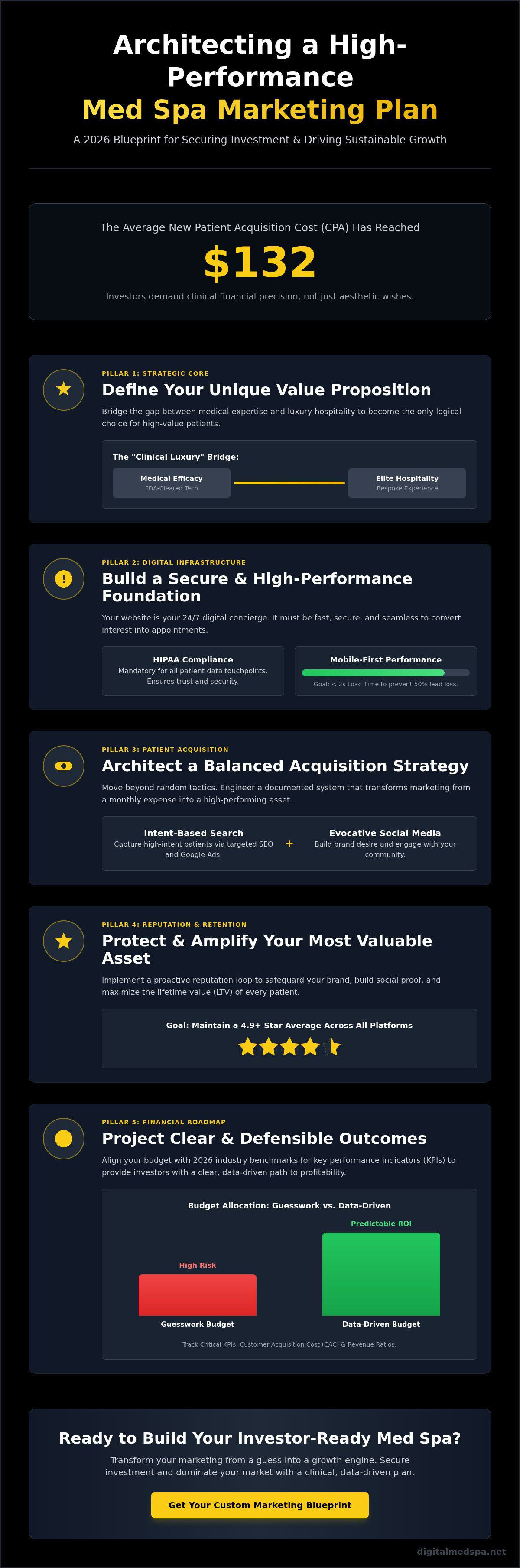
Why do most aesthetic practices fail to secure high-level funding despite having beautiful treatment rooms? It's often because their med spa business plan marketing section is a list of aesthetic wishes rather than a documented architecture for patient acquisition. In a market where the average new patient acquisition cost has reached $132, investors aren't looking for creative flair. They're looking for clinical financial precision. You likely feel the pressure of a saturated market where standing out feels like an uphill battle, and it's exhausting to guess which channels deserve your hard-earned capital. We understand that balancing the luxury of a wellness retreat with the rigors of medical data is a delicate art.
This guide will teach you how to architect a marketing strategy that secures investment and builds a sustainable engine for growth. We'll provide the exact KPIs you need to track, from Google Ads performance to sophisticated SEO benchmarks, ensuring your practice remains luminous in a crowded landscape. You'll gain a clear roadmap for clinical and financial expansion that transforms your marketing from a monthly expense into a high-performing asset. Let's explore how to blend bespoke hospitality with the technical depth required to dominate the 2026 aesthetic market.
Key Takeaways
Define a bespoke unique value proposition that differentiates your clinical expertise from the saturated retail market.
Establish a secure digital infrastructure by prioritizing HIPAA compliance and mobile-first performance for your 24/7 digital concierge.
Architect a high-performance med spa business plan marketing section that balances intent-based search visibility with evocative social media engagement.
Implement a reputation loop to safeguard your practice’s most valuable asset and maximize the lifetime value of every patient.
Project clear financial outcomes by aligning your budget with 2026 industry benchmarks for customer acquisition costs and revenue ratios.
Table of Contents
The Strategic Core: Defining Your Med Spa Unique Value Proposition
The marketing section of your business plan functions as the vital engine driving your financial projections. It's the bridge between clinical potential and realized revenue. When crafting the elements of a marketing plan, you must demonstrate how your specific niche generates predictable growth. Whether you specialize in advanced body contouring, restorative anti-aging, or holistic wellness, your focus must be surgical. A diluted brand message leads to diluted profits. Investors in 2026 look for a specialized "Patient Acquisition Architecture" that prioritizes precision over broad, generic appeals.
Your med spa business plan marketing section should articulate the "Clinical Luxury" bridge. This is the precise point where medical efficacy meets the high-end hospitality of a wellness retreat. It's not just about providing a service; it's about the bespoke experience of rejuvenation. Your practice is the only logical choice for clients because you offer a sophisticated blend of safety and radiance that local competitors cannot replicate. Our practice offers the discerning professional a bespoke, science-led path to rejuvenation, ensuring a luminous return to natural confidence through advanced clinical precision and elite hospitality.
Audience Segmentation and Patient Personas
Effective marketing requires looking beyond basic age and income brackets. You must explore the psychographics of your patients. What keeps them awake at night? It's often the fear that their external appearance no longer reflects their internal vitality. We focus on "The High-Value Patient," individuals who aren't looking for a one-time discount but a long-term aesthetic partnership. You are mapping an emotional journey that begins with a specific skin concern and ends with a renewed sense of luminous confidence. This journey must be documented with specific touchpoints that reassure the patient of your clinical authority at every step.
The Competitive Advantage Framework
A rigorous SWOT analysis is essential for identifying gaps in the local market. Many practitioners offer excellent clinical results but fail to provide a seamless digital experience. You can win by identifying competitor weaknesses such as frustrating website UX that hinders booking or a lack of localized SEO that makes them invisible to high-intent searchers. Documenting your unfair advantage is critical. This might include:
Exclusive access to 2026-gen FDA-cleared technology.
Proprietary treatment protocols that deliver faster, more natural-looking results.
Elite staff training certifications that exceed standard medical requirements.
A sophisticated reputation management system that maintains a 4.9-star average across all platforms.
By identifying these gaps, you prove to investors that your med spa business plan marketing section is built on a foundation of clinical authority and market awareness. It's about showing that you don't just exist in the market; you've engineered a way to lead it.
Digital Infrastructure: The Foundation of Your Marketing Section
Your digital presence isn't a static asset. It's a 24/7 digital concierge that mirrors the luxury of your physical clinic. When documenting your med spa business plan marketing section, you must treat your website as the primary engine for patient acquisition. According to the SBA's guide to writing a business plan, detailing your sales and marketing technology is vital for proving operational readiness to lenders. In 2026, this means more than just a gallery of before-and-after photos. It requires a high-performance framework built on technical precision and unwavering security.
Security is the first pillar of clinical authority. As of December 1, 2025, HIPAA regulations demand that every digital touchpoint safeguarding patient data must be fully encrypted. This includes your lead capture forms and integrated booking engines. Beyond compliance, your infrastructure must prioritize the mobile-first consumer. A site that takes longer than two seconds to load can lose 50% of potential leads. Reducing friction through high-performance booking engines allows patients to transition from interest to appointment with the same ease they expect during a bespoke consultation. If you're looking to optimize your patient journey, a comprehensive digital audit can reveal hidden friction points in your current infrastructure.
High-Performance Med Spa Website Design
A truly effective med spa website design serves as a silent salesperson. It builds "Visual Trust" through high-end photography and a clean user interface that reflects your clinic's aesthetic. Your lead-capture architecture must be intuitive, guiding visitors from a scientific explanation of a laser treatment to a personalized consultation request. For a med spa generating $100,000 in monthly revenue, industry benchmarks suggest allocating $1,000 to $1,500 monthly for website maintenance and SEO to ensure this engine stays optimized. This investment ensures your digital storefront remains as polished and professional as your treatment rooms.
The Long-Term SEO Strategy
While ads provide immediate traffic, med spa seo builds digital equity that compounds over time. Your med spa business plan marketing section must outline a search authority roadmap focused on three pillars: technical health, content authority, and local visibility. Content authority, or E-E-A-T, is particularly critical for medical procedures. Your content calendar should focus on high-intent procedures like Semaglutide or advanced skin rejuvenation. By providing expert education on these topics, you establish yourself as a trusted authority before the patient even enters your facility. This long-term visibility ensures your practice remains luminous in search results, capturing demand whenever a potential client seeks clinical excellence.
Patient Acquisition: Architecting the Paid Advertising Strategy
A sophisticated patient acquisition model requires an omnichannel approach. This ensures your clinic remains visible wherever your ideal patient spends their time. When developing your med spa business plan marketing section, you must differentiate between intent-based and interruption-based advertising. Google Ads serve patients with high intent who are actively seeking a solution, such as "laser hair removal near me." Conversely, social media platforms allow you to introduce bespoke treatments to a curated audience through evocative visual storytelling. This duality creates a robust pipeline that captures existing demand while simultaneously generating new interest.
Budget allocation is a critical variable that depends on your practice's maturity. Startups typically require a more aggressive investment, often reaching up to 20% of projected revenue to establish market presence. Established practices can often maintain a steady growth trajectory with an investment of 5% to 10%. According to data from early 2026, the average new patient acquisition cost is $132. Architecting a med spa advertising strategy that accounts for these benchmarks is essential for proving the financial viability of your model to potential investors. A winning medical spa marketing plan must integrate these paid channels with a deep understanding of patient feedback and lifestyle preferences.
Google Ads: Capturing High-Intent Demand
Google Ads act as your clinical precision tool. By targeting "Bottom-of-Funnel" keywords, you capture patients at the exact moment they are ready to book. In 2026, Google Ads for med spas typically range from $6 to $20 per click. To maximize this spend, every ad must lead to a dedicated, high-performance landing page designed specifically for conversion. Advanced tracking is no longer optional. You must be able to trace a patient's journey from the initial click to the final procedure, ensuring every dollar of your ad spend is accounted for in your revenue projections. This data-driven approach transforms marketing from a cost center into a predictable growth engine.
Social Media: Building Brand Radiance
While Google captures demand, platforms like Instagram and Facebook build brand radiance. These channels are ideal for patient education and visual storytelling. A well-curated gallery of "Before and After" photos serves as clinical proof of your efficacy, reassuring patients of the natural-looking results they can expect. Meta ads offer exceptional targeting capabilities, allowing you to reach specific lifestyle and income brackets. For these platforms, a cost per lead below $45 is considered strong, while top-tier campaigns often achieve results below $30. This interruption-based strategy ensures your practice remains top-of-mind for the modern, aesthetic-conscious consumer who values both safety and sophistication.
Retention and Reputation: Protecting Your Most Valuable Asset
Profitability within a modern aesthetic practice isn't defined by the initial consultation. It's built on the long-term Lifetime Value (LTV) of patients who trust your clinical precision for years. While acquisition strategies fill your calendar, retention protects your bottom line. Your med spa business plan marketing section must describe a robust "Reputation Loop" where clinical excellence transforms into digital authority. This ecosystem ensures that every luminous result shared by a patient feeds back into your SEO and conversion metrics, creating a self-sustaining growth engine.
Maintaining this delicate balance requires a sophisticated technology stack. You can't rely on manual follow-ups in a 2026 market. Partnering with an elite medical practice marketing agency allows you to automate these complex nurturing sequences while you focus on patient care. This partnership ensures your practice maintains a high retention rate and a pristine digital presence without burdening your clinical staff. It's about creating a culture of excellence that is documented, measured, and scaled through expert management.
Reputation Management and Review Generation
Your business plan should detail an automated strategy for review acquisition. In 2026, the speed of your response is as important as the sentiment of the review itself. Google Business Profile optimization relies heavily on these interactions to establish local trust. When negative feedback occurs, it must be met with clinical professionalism and grace. This demonstrates to prospective patients that your commitment to safety and satisfaction is unwavering. Consistent, high-quality reviews are the digital proof of your bespoke care.
Email and SMS: The Loyalty Engine
Personalization is the hallmark of high-end hospitality. Your database should be segmented by treatment interest, allowing for bespoke messaging that resonates with specific patient needs. The industry has moved beyond generic blasts to AI-personalized newsletters that predict when a patient is ready for their next rejuvenation session. Automation handles appointment reminders, post-care instructions, and anniversary offers with surgical precision. This ensures no patient feels like a number. If you're ready to secure your practice's future, connect with our team for a bespoke strategy session today.
The Financial Roadmap: Budgeting and KPI Projections
The final component of a sophisticated med spa business plan marketing section is the financial roadmap. This section transforms clinical ambition into fiscal reality. Lenders and investors prioritize clarity over optimism. They look for a documented understanding of how every dollar invested translates into patient arrivals. In 2026, industry benchmarks suggest that established, profitable med spas should allocate 5% to 10% of their gross revenue toward marketing. For a practice generating $1.39 million annually, this results in a monthly investment of approximately $5,800. Startups must be more aggressive, often dedicating up to 20% of projected revenue to pierce a saturated market.
Your plan must clearly define the relationship between Customer Acquisition Cost (CAC) and Lifetime Value (LTV). Current data from early 2026 indicates the average new patient acquisition cost is $132, while the average cost per lead sits at $39. To ensure sustainability, your LTV must significantly outweigh your CAC. Investors want to see that you aren't just buying one-time visits but are building a loyal patient base that returns for recurring treatments like neurotoxins or advanced skin rejuvenation. A transparent 12-month budget breakdown proves you've accounted for the seasonal fluctuations inherent in the aesthetic industry.
Allocating Your Marketing Dollars
Effective budgeting follows the 70/20/10 rule. You should dedicate 70% of your capital to proven channels like med spa marketing essentials, including SEO and Google Ads. Allocate 20% to emerging opportunities such as influencer partnerships on short-form video platforms. The final 10% is reserved for experimental tactics like AI-driven hyper-personalization. For a med spa targeting $100,000 in monthly revenue, a typical allocation includes $1,000 to $1,500 for website health and SEO, $2,000 to $3,000 for Google PPC, and $1,500 to $2,000 for paid social media and retargeting.
Tracking and Measuring ROI
Success in modern aesthetics is measured through SMART goals. Every campaign must be Specific, Measurable, Achievable, Relevant, and Time-bound. By integrating your CRM with your advertising platforms, you create a transparent attribution model that proves which treatments drive the highest profit margins. Investors look for these five specific KPIs:
Cost Per Lead (CPL): Maintaining an average near $39.
Lead-to-Consultation Rate: The efficiency of your front-desk concierge.
Patient Acquisition Cost (CAC): Benchmarked against the $132 industry average.
Retention Rate: The percentage of patients returning within six months.
Return on Ad Spend (ROAS): The direct revenue generated from paid media.
Implementing a quarterly review process allows you to pivot strategies based on real-time data. This ensures your practice remains both luminous and profitable in a shifting landscape.
Engineering Your Path to Aesthetic Market Leadership
Success in the modern aesthetic industry transcends clinical talent; it requires a meticulously documented framework for patient acquisition. Your med spa business plan marketing section functions as the essential blueprint that aligns your medical precision with the expectations of high-end hospitality. By integrating the digital infrastructure and financial projections discussed throughout this guide, you transform your strategy from a simple document into a living engine for growth. This holistic approach ensures that your practice doesn't just enter the market but defines it through consistent authority and brand radiance.
Digital Med Spa specializes in high-performance growth, delivering 2026-ready digital strategies where clinical efficacy meets premium luxury branding. We understand the nuances of maintaining a luminous reputation while scaling your operations with surgical precision. If you're ready to move beyond fragmented tactics and implement a unified roadmap for clinical and financial success, we're prepared to be your partner in this journey. Architect your aesthetic growth with a bespoke consultation today. Your vision for a premier practice is attainable; let's ensure your clinical excellence receives the visibility it deserves.
Expert Guidance for Your Med Spa Marketing Strategy
What is the most important part of a med spa marketing section?
The patient acquisition architecture is the most critical element because it proves your revenue model is repeatable and scalable. It's not enough to list digital channels; you must demonstrate the logical flow from a patient’s initial skin concern to a confirmed clinical consultation. This structural clarity reassures investors that your growth is engineered through precise data rather than clinical guesswork.
How much should a new med spa budget for marketing in their business plan?
New practices should allocate up to 20% of their projected revenue to marketing during the initial launch phase to establish market presence. This investment level is necessary to pierce a saturated landscape and build early search authority against established local competitors. Once your practice reaches a stable patient volume, this figure typically moves toward the 5% to 10% industry benchmark for sustained growth.
Do I need to include social media in my formal business plan?
Social media is an essential component of a modern plan as it serves as your primary tool for visual storytelling and brand radiance. It functions as a digital portfolio where prospective patients verify your clinical results through curated galleries and educational content. Your plan should detail how you'll maintain a sophisticated aesthetic while strictly adhering to 2026 medical advertising and HIPAA regulations.
How do I prove my marketing strategy will work to a bank or investor?
You prove the viability of your strategy by utilizing historical industry benchmarks and a rigorous attribution model that connects ad spend to procedure revenue. By demonstrating a clear understanding of the $132 average patient acquisition cost, you show a level of fiscal responsibility that banks value. Investors are moved by data-backed projections that show a clear path to a high lifetime value for every patient acquired.
What are the best KPIs to include in a med spa marketing plan?
Your med spa business plan marketing section should highlight five key metrics: Cost Per Lead (CPL), New Patient Acquisition Cost (CAC), Return on Ad Spend (ROAS), Lifetime Value (LTV), and patient retention rate. These indicators provide a 360-degree view of your marketing efficiency and long-term clinical profitability. Tracking these ensures you can pivot your strategy with precision based on real-time financial performance.
Is SEO or PPC better for a new med spa business plan?
A balanced med spa business plan marketing section must include both to manage immediate cash flow and long-term digital equity. PPC provides the instant patient volume required to meet early revenue targets, while SEO builds the organic authority that reduces your acquisition costs over time. Relying on only one creates a strategic vulnerability that sophisticated lenders will identify as a significant risk factor.
How often should I update the marketing section of my business plan?
You should perform a comprehensive strategy review every 90 days to align with shifting aesthetic trends and search engine algorithm updates. Monthly updates are necessary for tracking tactical KPIs to ensure your ad spend remains optimized and efficient. This rhythmic approach allows your practice to remain agile and responsive to both competitor moves and the release of new clinical technology.
Should I mention my competitors in the marketing section?
Including a competitor analysis is vital to show you understand the local landscape and have identified specific gaps in their digital presence or service offerings. By highlighting their weaknesses, such as poor website performance or a lack of social proof, you clarify your own unfair advantage. This demonstrates to lenders that your practice isn't just another entry in the market but a superior clinical alternative.


Comments