
Master the Math of Aesthetics: Calculating Med Spa Marketing ROI in 2026

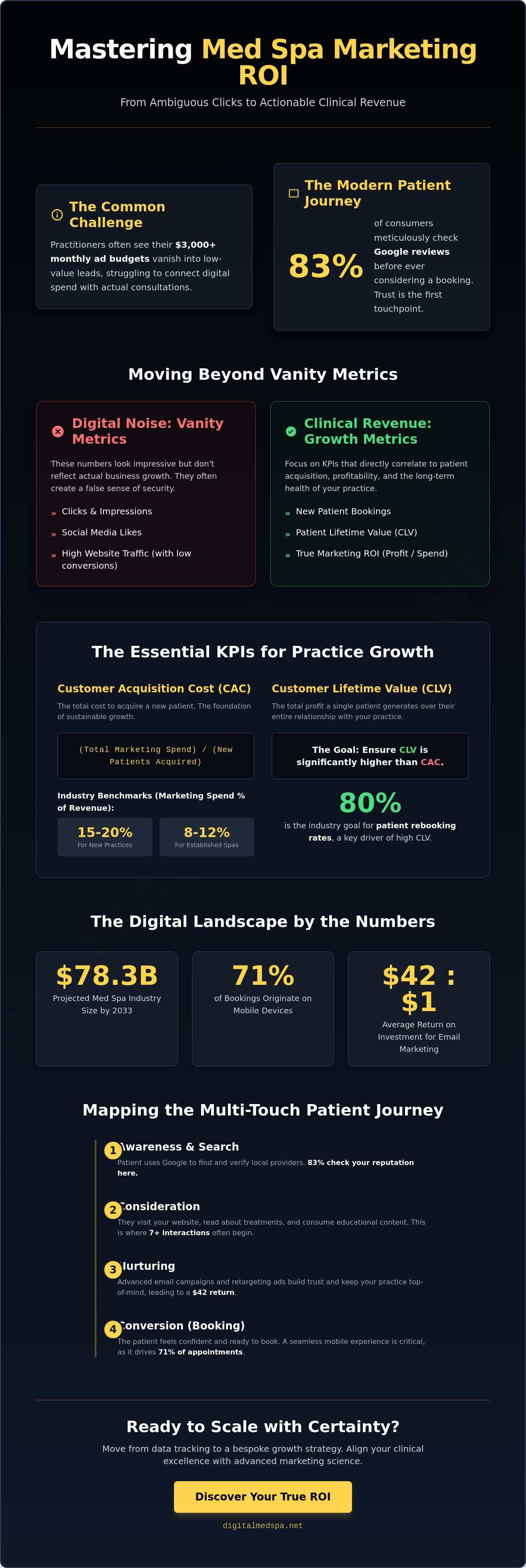
Why do 83% of consumers meticulously check Google reviews before choosing a provider, yet most practitioners still struggle to track the exact path from a digital click to a clinical consultation? You've likely felt the frustration of watching $3,000 monthly ad budgets vanish into a sea of low-value leads without knowing which campaign actually filled your chair. It's a common challenge in an industry projected to reach $78.3 billion by 2033. Mastering the art of calculating med spa marketing ROI is no longer a luxury; it's a clinical necessity for the modern practice.
You deserve the same precision in your business metrics that you provide in your treatment rooms. We'll show you how to move beyond basic ROAS to understand true profitability. By leveraging a framework that turns data into a bespoke growth strategy, you can scale with certainty. This guide reveals the formula for measuring marketing efficacy, from the 71% of bookings originating on mobile devices to the $42 return seen in advanced email campaigns. You'll gain the confidence to scale your winning ads and secure the 80% rebooking rate that defines a luminous, sustainable brand.
Key Takeaways
Distinguish between vanity metrics and clinical revenue to ensure your marketing investment reflects genuine practice growth rather than mere digital noise.
Refine your financial precision by calculating med spa marketing ROI through the lens of both immediate acquisition costs and long-term patient lifetime value.
Identify the hidden profitability in your service menu by comparing high-volume gateway treatments with high-margin aesthetic procedures.
Map the modern patient journey to understand how multi-touch attribution captures the seven or more interactions required before a client feels ready to book.
Move beyond simple data tracking toward a bespoke growth strategy that aligns your clinical excellence with advanced marketing science.
Table of Contents Beyond the Spreadsheet: Redefining Med Spa Marketing ROI for 2026 The Essential KPIs: Measuring the Pulse of Your Aesthetic Practice High-Volume vs. High-Value: Analyzing ROI by Treatment Category The Attribution Architecture: Mapping the Modern Patient Journey From Metrics to Momentum: Scaling Your Practice with Digital Med Spa
Beyond the Spreadsheet: Redefining Med Spa Marketing ROI for 2026
Spreadsheets provide the skeleton of your business, but they rarely capture its heart. Traditional marketing math often fails because it treats aesthetic treatments like commodities rather than bespoke medical services. In a landscape where the global medical spa industry is projected to reach $78.3 billion by 2033, your focus must shift from mere visibility to clinical precision. You don't just need more patients; you need the right patients who value the safety and sophistication of your brand.
There is a vast difference between "Vanity Metrics" and "Clinical Revenue." An agency might report a 40% increase in clicks, but if those clicks don't result in patients in the chair, the spend is wasted. True success in calculating med spa marketing ROI requires looking past the digital noise to see the actual impact on your bottom line. It's about moving beyond the surface level to understand how every dollar spent contributes to the long-term health of your practice.
To truly master your practice's growth, you must move beyond basic accounting toward a deeper understanding marketing return on investment. This involves seeing ROI as the intersection of patient trust and marketing efficiency. In 2026, the market demands a transition from high-volume outreach to high-value patient acquisition. Your marketing should feel like a natural extension of your clinical excellence, creating a seamless journey from the first digital touchpoint to the final aesthetic result.
The Evolution of Aesthetic Patient Acquisition
The patient journey has transformed significantly since 2020. Today, 83% of consumers use Google to verify your reputation before they ever consider booking. With market saturation driving up baseline costs, a brand voice rooted in quiet confidence is essential. This approach lowers long-term marketing friction by attracting patients who value natural-looking results and medical safety over discount-driven offers. It's a more sustainable way to grow in a competitive environment.
Why ROI is Your Most Important Diagnostic Tool
Think of ROI as a diagnostic tool rather than just a financial result. It allows you to identify leaks in your booking funnel where potential revenue is escaping. For instance, if 78% of your local mobile searches result in appointments within 24 hours, but your rebooking rate is below the 80% industry goal, your data is telling a specific story. You aren't just spending money; you're investing in the future radiance of your practice. Data-driven decisions allow you to scale with the same precision you use in the treatment room.
The Essential KPIs: Measuring the Pulse of Your Aesthetic Practice
Measuring the vitality of your practice requires more than a casual glance at your bank balance. Just as you monitor a patient's vital signs during a procedure, you must track specific Key Performance Indicators (KPIs) to ensure your business remains healthy and luminous. These metrics allow you to see beyond the surface of your daily operations, providing a clear view of how your marketing efforts translate into actual clinical revenue. By understanding these numbers, you gain the quiet confidence needed to make informed decisions about your future growth.
Many practitioners confuse Return on Ad Spend (ROAS) with true profitability. While ROAS tells you how much revenue a specific campaign generated, it ignores the cost of medical supplies, staff time, and facility overhead. Calculating med spa marketing ROI demands a more rigorous approach that accounts for these underlying margins. By focusing on your Customer Acquisition Cost (CAC), you can determine exactly what you're paying to bring a new patient into the chair and whether that investment is sustainable.
Calculating Your CAC with Clinical Precision
To find your CAC, divide your total marketing spend, including agency fees and software subscriptions, by the number of new patients acquired during a specific period. For a new practice seeking rapid patient acquisition, allocating 15% to 20% of revenue to marketing is a standard industry benchmark. Established spas often maintain their momentum with an 8% to 12% allocation. If your CAC for a specific treatment exceeds the profit of the first visit, it's essential to look at the broader patient journey to find the true value of that acquisition.
The Power of Customer Lifetime Value (CLV)
The first appointment is merely the beginning of a patient's aesthetic journey. Customer Lifetime Value (CLV) measures the total revenue a patient generates over a 12-month period or longer. With an industry target rebooking rate of 80% or higher, a single Botox patient can evolve into a loyal client who explores bespoke skin rejuvenation and advanced body contouring plans. High retention rates drastically lower your overall marketing costs, as keeping an existing patient is significantly more cost-effective than finding a new one through cold acquisition.
Your front desk plays a critical role in this financial ecosystem. Even the most advanced ad campaigns fail if leads aren't converted into consultations with professional grace. Since 78% of local mobile searches result in an appointment within 24 hours, your team's responsiveness is paramount to maintaining a high lead-to-patient conversion rate. If you're ready to refine these metrics and optimize your practice's performance, exploring a bespoke growth strategy can provide the clinical clarity you need to scale with confidence.
High-Volume vs. High-Value: Analyzing ROI by Treatment Category
Numbers don't always tell the full story of your practice's vitality. A 10:1 return on a Botox campaign looks stunning on a dashboard, but it might yield less net profit than a 3:1 return on a Semaglutide program once you factor in the high cost of goods and competitive pricing pressures. When you're calculating med spa marketing ROI, it's essential to look beyond the top-line revenue and analyze the specific margins of each treatment category. This approach ensures your marketing spend isn't just generating activity, but is actually driving genuine clinical profitability.
You must also consider the "chair time" cost associated with each procedure. A quick injectable appointment requires fewer staff resources than a multi-hour laser session. However, high-ticket procedures often have a much higher ceiling for profit per hour worked. Balancing your marketing portfolio means using "quick wins" to maintain a steady pulse of new patients while strategically promoting the "big procedures" that secure your practice's financial future. This duality allows you to maintain a luminous brand presence while maximizing your operational efficiency.
The ROI of Injectables and Skin Health
Neurotoxins are the industry's most popular entry point, yet they're also the most competitive. Leveraging sophisticated med spa marketing allows you to use these high-volume services as a foundation for a recurring revenue base. Since most med spas report a 3x to 7x return on investment from social media marketing, these platforms are ideal for promoting accessible entries. The goal isn't just the initial injection; it's the 80% rebooking rate that turns a single visit into a lifelong relationship. You're tracking the natural transition from a simple facial to a comprehensive, bespoke treatment plan.
Maximizing Returns on High-Ticket Aesthetic Services
Services like body contouring or deep laser resurfacing involve a longer, more thoughtful patient journey. These high-ticket items require more nurturing because the financial and physical commitment is greater for the client. Effective med spa advertising in 2026 focuses on architecting this journey, providing the education and reassurance needed to convert high-intent leads. Because these procedures drive significant ROI, they justify a higher-touch follow-up process from your team. With the industry projected to grow at a CAGR of 15.77% through 2033, focusing on these high-value segments ensures your practice stays at the forefront of modern aesthetics.
The Attribution Architecture: Mapping the Modern Patient Journey
The path a patient takes from discovering your practice to sitting in your treatment chair is rarely a straight line. It is a sophisticated architecture of interactions where digital grace meets clinical authority. Most patients encounter seven or more digital touchpoints before they feel enough trust to book a consultation. This multi-touch reality makes calculating med spa marketing ROI a complex but rewarding diagnostic exercise. You must understand which channel introduced the patient through first-touch attribution and which one finally prompted the booking via last-touch attribution.
While social media often provides that initial spark of inspiration, med spa seo serves as the silent authority that validates your expertise. When a patient searches for a bespoke rejuvenation plan after seeing a luminous Instagram post, your search presence provides the assisted conversion that secures the lead. Tracking these offline conversions by connecting phone calls directly to your Electronic Medical Record (EMR) system is the only way to close the loop. It allows you to see the true efficacy of your spend beyond simple clicks.
Closing the Loop with Your CRM and EMR
Your marketing data shouldn't live in a silo. For clinical precision, your CRM must communicate fluently with your EMR, tagging every lead by its original source. This integration allows you to identify which high-quality traffic sources result in actual procedures rather than just inquiries. You must also account for "Dark Social," those invisible word-of-mouth recommendations that happen in private messages or over dinner. These interactions often amplify your recorded digital ROI in ways that standard tracking might miss.
Optimizing the Conversion Engine
A high-performance med spa website design acts as your practice's 24/7 closer. Since 71% of bookings now originate from mobile devices, a friction-free experience is non-negotiable. If your site takes longer than the recommended three seconds to load, you're effectively wasting your ad spend on a lead that will bounce before they see your results. A fast, mobile-optimized clinical website ensures that the interest generated by your marketing is captured and converted with the same elegance found in your physical spa. To see how these elements can work together for your practice, you can request a bespoke digital audit to reveal your current attribution gaps.
From Metrics to Momentum: Scaling Your Practice with Digital Med Spa
Turning raw data into sustainable momentum requires more than a software subscription. It demands a partnership that understands the delicate balance between medical efficacy and premium hospitality. At Digital Med Spa, we move your practice beyond the static rows of a spreadsheet to create a bespoke growth strategy that reflects your unique clinical authority. By calculating med spa marketing ROI with this level of depth, you stop guessing and start leading your market with quiet confidence. Scaling isn't just about more leads. It's about better leads and higher margins.
Reputation management is a critical, often overlooked component of this financial equation. Since 83% of consumers use Google to check reviews before choosing a business, your digital reputation acts as either a lubricant or a filter for your marketing spend. A practice with a pristine, authoritative online presence will naturally see a lower cost per acquisition than a competitor with inconsistent social proof. We treat your reputation as a financial asset, ensuring that every dollar invested in advertising is supported by the luminous trust you've built with your patients.
The Digital Med Spa Advantage
Our approach integrates sophisticated business coaching with high-performance marketing. We don't just deliver reports filled with vanity metrics like "likes" or "impressions." Instead, we provide transparent reporting that focuses on clinical revenue and practice profit. This partnership approach allows you to see exactly how your customized campaigns reflect your clinical excellence while driving measurable growth. You gain a partner who is as meticulous about your business health as you are about your patients' aesthetic results.
Architecting Your Growth Map
Transitioning from "marketing-led" growth to "ROI-driven" scaling is the hallmark of a mature practice. In an industry projected to reach $78.3 billion by 2033, the expertise of a specialized medical practice marketing agency becomes a strategic necessity. We help you identify the specific levers that move the needle, from optimizing the 71% of bookings that originate on mobile to refining your 12-month customer lifetime value. This level of precision ensures your practice remains at the forefront of modern aesthetics without sacrificing your operational peace of mind.
The first step toward this refined future is a clear understanding of your current performance. We invite you to audit your existing 2026 marketing strategy to identify hidden leaks and untapped opportunities for expansion. By calculating med spa marketing ROI through our proprietary lens, you can secure the clinical and financial success your expertise deserves. Request your comprehensive ROI audit today and begin architecting a practice that radiates both beauty and profitability.
Cultivating a Luminous Future for Your Practice
Your practice's evolution from a local clinic to a market leader depends on the precision of your financial diagnostics. By moving beyond basic spreadsheets and truly mastering the art of calculating med spa marketing ROI, you've taken the first step toward a more predictable and profitable future. You now understand that a high rebooking rate, currently targeted at 80% or higher, is the foundation of long-term radiance. You also recognize that tracking the seven or more digital touchpoints required for a modern booking is essential for protecting your clinical investment.
Since 2018, Digital Med Spa has specialized in this exact intersection of clinical authority and digital growth. We don't just offer marketing; we provide a holistic partnership that integrates business coaching with high-value patient acquisition strategies. This dual approach ensures your practice doesn't just grow in volume but scales in value. It's time to stop guessing and start leading with data-backed certainty.
Architect Your Practice Growth with a Custom ROI Audit
The journey toward a more sophisticated practice begins with a single, precise measurement. We're here to help you illuminate the path ahead and restore the confidence you feel in your business's future.
Frequently Asked Questions
What is a good ROI for a med spa marketing campaign in 2026?
A healthy return for social media marketing typically ranges between 3x and 7x your investment. Email marketing remains exceptionally potent, often delivering between $36 and $42 for every dollar spent. These benchmarks represent the standard for a well-optimized aesthetic practice. If your returns fall below these levels, it's a signal to refine your targeting or enhance your brand's clinical appeal to attract higher-value patients.
How do I calculate the cost per lead (CPL) for my aesthetic clinic?
To find your cost per lead, divide your total monthly marketing investment by the number of inquiries received. This calculation should include your ad spend, agency fees, and software costs for total precision. Tracking this metric allows you to evaluate the efficiency of your acquisition channels. It's a foundational step in the broader process of calculating med spa marketing ROI and ensuring your budget is utilized with clinical accuracy.
Why is my ROI low despite having a lot of website traffic?
Low conversion despite high traffic often stems from friction in the patient journey. If your website takes longer than three seconds to load, potential clients will bounce before exploring your results. Additionally, 83% of consumers check Google reviews before booking. If your digital reputation doesn't mirror your clinical excellence, visitors won't feel the confidence required to move from browsing to booking a consultation.
Should I prioritize SEO or PPC for the best short-term ROI?
PPC is the superior choice for immediate results, as it places your practice in front of high-intent patients searching for specific treatments. It offers a quick win to fill your chair while you build your long-term authority. However, SEO provides the sustainable foundation that lowers your future acquisition costs. A balanced strategy uses PPC for speed and SEO to establish the enduring trust that defines a premium brand.
How does patient retention impact my overall marketing ROI?
Retention is the most effective way to multiply your marketing returns. Since acquiring a new patient is more expensive than keeping an existing one, reaching an 80% rebooking rate significantly boosts your bottom line. Loyal patients often transition from entry-level services to high-value, bespoke treatment plans. This recurring revenue stabilizes your practice and ensures every acquisition dollar works harder over the client's lifetime.
Can I track ROI if my patients call the office instead of booking online?
Yes, tracking phone conversions is essential since 78% of local mobile searches result in an appointment within 24 hours. By using dynamic call tracking software, you can attribute each call to the specific ad or keyword that prompted it. Integrating this data with your CRM allows you to close the loop between a digital click and a clinical consultation, providing a complete picture of your marketing efficacy.
How much should a med spa spend on marketing to see a positive return?
New practices should allocate between 15% and 20% of their revenue to marketing for rapid acquisition. Established med spas can maintain their momentum by spending between 8% and 12% of their revenue. For paid advertising on platforms like Instagram, a monthly budget of $1,000 to $3,000 is recommended to gather enough data for meaningful optimization. This investment ensures your brand remains visible in a competitive $78.3 billion market.
What is the difference between ROAS and ROI in medical marketing?
ROAS measures the revenue generated specifically from your ad spend, providing a narrow view of campaign performance. ROI is a more comprehensive diagnostic tool that factors in your total investment, including medical supplies and staff overhead. While a high ROAS looks impressive, calculating med spa marketing ROI is the only way to confirm if your campaigns are truly profitable. It ensures your practice scales with financial health and clinical integrity.


Comments