
Advertising for Non-Invasive Body Contouring: The 2026 Guide to Patient Acquisition

Updated: Jun 19
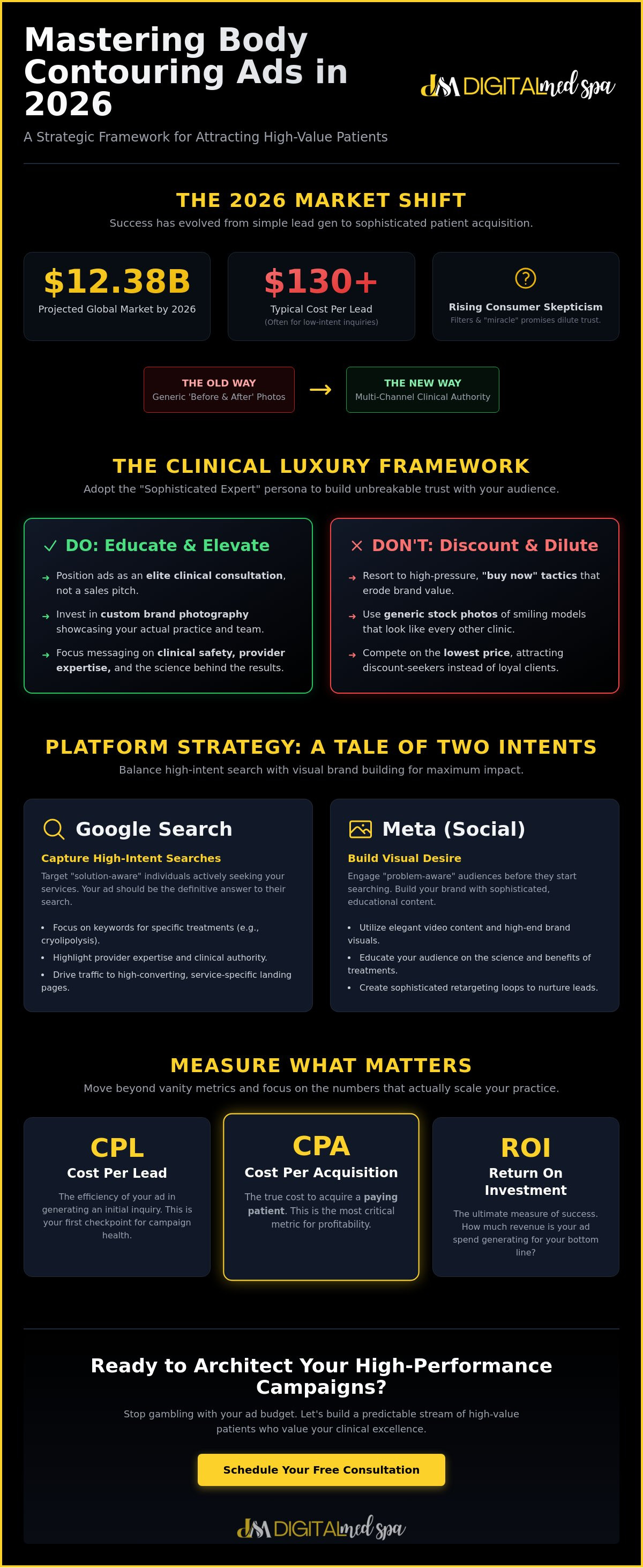
With the global non-invasive body contouring market expected to reach $12.38 billion in 2026, the competition for premium patients has never been more sophisticated. You likely feel the pressure of rising costs, where a single lead can cost up to $130 and still result in a consultation no-show. It's frustrating to watch your ad budget vanish into platform rejections or low-intent inquiries that don't reflect the clinical excellence of your practice. Effective advertising for non-invasive body contouring shouldn't feel like a gamble. Instead, it should serve as an elegant extension of your luxury brand experience.
You understand that attracting high-value patients requires more than just a basic before and after photo. You need a strategy that balances clinical authority with the inviting atmosphere of a wellness retreat. This guide promises to help you master the art of architecting high-performance campaigns that resonate with discerning clients who value quality over a discount. We will examine the latest 2026 regulatory shifts, compare the ROI of Google versus Meta, and outline a framework for building a consistent stream of high-value consultations that actually convert.
Key Takeaways
Learn how to navigate the 2026 market shift by evolving your advertising for non-invasive body contouring into a multi-channel strategy that successfully overcomes growing consumer skepticism.
Discover how to adopt the "Sophisticated Expert" persona to create ad copy that feels like an elite clinical consultation rather than a high-pressure sales pitch.
Master the balance between capturing high-intent searches on Google and building visual desire through sophisticated retargeting loops on Instagram and Facebook.
Optimize your digital presence with the "Landing Page Luxury" standard to ensure your high-end ad traffic converts into predictable, high-value consultations.
Move beyond vanity metrics by focusing on the three critical numbers—CPL, CPA, and ROI—that directly impact your practice's bottom line and ability to scale.
Table of Contents
The Evolution of Body Contouring Advertising in 2026
The landscape of advertising for non-invasive body contouring has shifted from simple lead capture to a sophisticated multi-channel patient journey. In 2026, you're no longer just competing with the clinic down the street. You're competing for attention in a market saturated with filters and miracle promises that have left consumers deeply skeptical. Success now requires a strategy that blends high-end hospitality with clinical authority. If your ads look like everyone else's, they'll be ignored. Trust is the new currency. As we examine the evolution of body contouring, we see a clear move away from generic "fat loss" claims toward comprehensive aesthetic refinement that honors the individual's natural features.
Traditional "before and after" photos are no longer enough to secure a high-value consultation. While these visuals remain important, they've become table stakes in a world where AI-generated images are commonplace. To stand out, you must architect an advertising experience that reflects the precision of your medical science. This means moving beyond broad targeting. You need a data-driven approach that identifies high-value patients based on their specific stage in the aesthetic journey. Your paid ads must act as the digital front door to your practice, offering a sense of safety and expertise before the patient even steps into your treatment room.
Understanding Modern Patient Intent
In 2026, patients are more informed than ever. You must differentiate between problem-aware searchers who are just noticing a change in their silhouette and solution-aware searchers who are looking for a specific technology like cryolipolysis. Today's premium consumers prioritize clinical safety and provider expertise over the lowest price. They want to know they're in expert hands. Modern advertising platforms now utilize AI to predict patient lifetime value (LTV) during the real-time ad auction, allowing you to bid more aggressively for the individuals most likely to become long-term, loyal clients of your practice.
The Technology Landscape: From Cryolipolysis to Muscle Stimulation
The global market for non-invasive body contouring is expected to be a $12.38 billion industry in 2026. This massive growth is driven by a diverse range of technologies that require distinct advertising approaches. You should categorize your creative assets based on the specific physiological benefits of each treatment. For example, your ad copy for muscle-stimulating technologies should focus on athletic refinement and strength, while cryolipolysis ads should speak to precision fat reduction. Matching specific patient pain points, such as post-weight-loss skin laxity or stubborn abdominal pockets, to these technological solutions allows your messaging to feel personalized and deeply relevant.
Practical Tip: Audit your current ad creative. If you're using the same stock imagery as your competitors, you're diluting your brand. Replace one generic ad this week with a high-quality video of your lead clinician explaining the science behind a specific treatment to immediately boost clinical authority.
The Clinical Luxury Framework: Positioning Your Ads
Positioning your practice in the 2026 market requires a departure from the high-pressure sales tactics that define lower-tier clinics. When you approach advertising for non-invasive body contouring, you must adopt the persona of the Sophisticated Expert. This voice feels less like a billboard and more like a private consultation. Your ad copy should mirror the calm, controlled environment of your facility, offering expert education rather than a frantic plea for a click. By striking a balance between the precision of medical science and the luxury of high-end hospitality, you signal to premium patients that they aren't just buying a procedure; they're entering a partnership for their aesthetic journey.
Visual storytelling is your most potent tool for establishing this authority. Generic stock photos of smiling models have lost their efficacy as consumers become hyper-aware of artificial marketing. Instead, invest in high-end, custom brand photography that showcases your actual clinical space and the meticulous nature of your team. These visuals should evoke a sense of tranquility and safety. When your creative assets reflect the reality of your practice, you bridge the trust gap before the first phone call occurs. If you're looking to refine this approach, you might consider how a tailored digital identity audit can reveal gaps in your current brand presentation.
Crafting the High-Value Narrative
In 2026, empowerment outperforms insecurity. Shame-based marketing that focuses on "fixing flaws" or "melting fat" creates a transactional relationship that attracts price-sensitive leads. To attract premium patients, pivot your narrative toward restoring confidence and aesthetic refinement. Use an upscale lexicon that emphasizes natural-looking results. This shift in tone is a core pillar of successful med spa marketing, as it aligns your services with self-care and wellness rather than a desperate correction of appearance.
The Role of Credibility and Safety in Creative
Safety is the cornerstone of luxury. Your ads must explicitly highlight your clinical credentials, such as your medical director's expertise or specific safety protocols. Citing FDA-cleared body contouring technologies within your ad overlays adds a layer of objective scientific validation. This is particularly vital in regions with evolving regulations, such as Texas, where physician delegation must be clear. Integrating your reputation management data, like a "4.9-star average from 200+ patient journeys," directly into your headlines builds immediate, verifiable trust.
Practical Tip: Review your current ad headlines. Replace aggressive verbs like "blast" or "destroy" with evocative lifestyle language like "sculpt," "define," or "enhance." This simple linguistic shift immediately elevates the perceived value of your advertising for non-invasive body contouring.
Platform Strategy: Google Search vs. Social Media
A singular approach to digital marketing is a relic of the past. In 2026, premium patients require an average of seven touchpoints before they feel confident enough to book a high-value consultation. You must view your digital presence as a cohesive ecosystem where every platform serves a distinct purpose. While Google captures those actively hunting for a solution, social media platforms like Instagram and Facebook create the initial spark of desire. Successful advertising for non-invasive body contouring relies on this synergy; it's the difference between a one-off click and a predictable stream of loyal patients.
According to the latest plastic surgery statistics, the demand for non-surgical refinement continues to climb, but so does the sophistication of the audience. Your budget allocation should reflect this reality. A balanced split between search and social allows you to capture existing demand while simultaneously filling your pipeline with future leads. This omnichannel approach to advertising for non-invasive body contouring ensures your brand remains top-of-mind as the patient moves from curiosity to commitment.
Google Ads for Med Spas: Capturing the Hunt
Precision bidding is the cornerstone of a profitable search strategy. You aren't just looking for clicks; you're looking for individuals searching for "body sculpting experts near me" or specific treatments like cryolipolysis. High-intent keywords are competitive, but they represent a patient who is ready to take action. To protect your budget, it's essential to use a robust negative keyword list. This filters out those seeking "cheap" or "DIY" alternatives, ensuring your med spa advertising spend is reserved for the premium demographic your practice serves.
Social Media Advertising: The Visual Boutique
While Google handles the hunt, social media acts as your visual boutique. Platforms like Instagram and TikTok are perfect for educational entertainment that highlights your clinical authority. Use high-end video content to show the science behind the results, which builds trust before the patient ever meets your team. Retargeting is where the magic happens. By showing behind-the-scenes luxury to those who've already visited your site, you reinforce your brand's position. Be mindful of Meta’s strict medical policies; focus on the journey and the expertise rather than making direct claims about body parts to avoid account rejections.
Practical Tip: Implement a cross-platform retargeting loop. If a lead visits your site via a Google search for "non-invasive fat reduction," ensure they see a high-end educational video on Instagram within 24 hours. This reinforces your authority across their entire digital landscape.
Beyond the Click: The High-Performance Conversion Engine
Your investment in advertising for non-invasive body contouring is only as effective as the destination where your traffic lands. Many practice owners treat their website as a digital brochure, yet in a high-stakes clinical environment, your site must function as a high-performance acquisition engine. If a prospective patient clicks a beautifully crafted ad only to arrive at a cluttered, slow-loading page, the trust you've built evaporates instantly. This "leaky bucket" is where most ad budgets die. To protect your ROI, your digital home must mirror the same level of clinical luxury and meticulous detail found within your physical treatment rooms.
Conversion Rate Optimization (CRO) is the bridge between a curious browser and a booked consultation. It's about removing every possible friction point that might cause a premium lead to hesitate. When you align your med spa website design with the sophisticated expectations of your audience, you transform your digital presence from a cost center into a predictable revenue generator. You can schedule a professional audit of your conversion funnel to identify exactly where you might be losing high-value patients.
Architecting the Landing Page
The "Landing Page Luxury" standard requires a seamless transition from the ad creative to the appointment request. We recommend the 3-click rule: a patient should be able to move from their initial click to a completed booking form in three steps or fewer. A 1-second delay in mobile load time can drop med spa conversions by 20%. To combat this, prioritize clean clinical imagery and fast-loading technical infrastructure. Integrating live social proof, such as verified reviews and video testimonials, directly near your booking form provides the final reassurance a patient needs to commit to their aesthetic journey.
Reputation Management as an Ad Accelerator
Your Google Business Profile health is the silent partner of your paid search performance. Platforms like Google Ads use external signals, including your average star rating and review frequency, to determine your ad quality score. By automating your review collection, you not only build a wall of trust around your brand but also lower your cost-per-click. Partnering with a specialized medical practice marketing agency ensures that your reputation management and advertising for non-invasive body contouring work in perfect harmony. This holistic approach ensures that every dollar spent on advertising is supported by a foundation of undeniable clinical authority.
Practical Tip: Perform a mobile speed test on your primary landing page today. If it takes longer than 2.5 seconds to become fully interactive, you're likely paying a "slow-site tax" in the form of higher bounce rates and wasted ad spend. Simple image compression and removing unnecessary scripts can often recover lost conversions immediately.
Measuring ROI: The Metrics That Actually Scale Practices
Vanity metrics like likes, shares, and impressions offer a false sense of security in a competitive market. For established practices, the only numbers that truly matter are those that correlate directly to your bottom line. When you invest in advertising for non-invasive body contouring, you need to look past the surface level of digital engagement. High-performance scaling requires a meticulous focus on three primary indicators: Cost Per Lead (CPL), Cost Per Acquisition (CPA), and overall Return on Ad Spend (ROAS). In 2026, where the estimated CPL for body contouring ranges between $80 and $130, precision in tracking is no longer optional; it is a requirement for survival.
Attribution modeling is the sophisticated lens through which you view your patient acquisition. It allows you to trace a $3,000 multi-treatment package back to the specific Google search or Instagram Reel that initiated the journey. Without this clarity, you're essentially guessing which half of your budget is working. By utilizing advanced Google Analytics reporting and CRM integration, you can identify the high-intent touchpoints that convert premium patients. This data-driven approach ensures that your capital is always flowing toward the most profitable channels.
Cost Per Lead (CPL): The price you pay to secure a name and contact method.
Cost Per Acquisition (CPA): The total marketing spend required to move a lead to a paid consultation.
Return on Investment (ROI): The net profit generated from your campaign relative to the total ad spend.
The Patient Lifetime Value (LTV) Equation
The first body contouring session is merely the entry point into your practice ecosystem. To see the true impact of your advertising for non-invasive body contouring, you must calculate ROI over a 12-month window rather than a 30-day snapshot. A patient who begins with fat reduction may later seek skin tightening or muscle stimulation as part of a holistic wellness plan. By implementing automated follow-up sequences through a CRM AI system, you can maximize the value of every lead, turning a single transaction into a long-term clinical relationship.
Scaling with Digital Med Spa
Our approach at Digital Med Spa transcends basic ad management. We provide the technical expertise and business coaching necessary to optimize your entire intake process. It isn't enough to generate leads; your team must be equipped to handle them with the same high-end hospitality found in your treatment rooms. We integrate Med Spa SEO, custom web design, and paid media into a cohesive national growth strategy. This ensures your brand reflects clinical excellence at every stage of the patient journey. Ready to architect your growth? Schedule a consultation with Digital Med Spa to begin your digital identity audit and start scaling with confidence.
Practical Tip: Review your intake data from the last 90 days. If your lead-to-consultation booking rate is below 20%, the issue likely lies in your response time rather than your ad creative. Implementing an AI-driven conversation tool can bridge this gap by providing instant, professional engagement 24/7.
Mastering the Future of Aesthetic Acquisition
Navigating the complexities of advertising for non-invasive body contouring in 2026 requires more than just a generous budget; it demands a strategic alignment of clinical authority and high-end hospitality. You've seen how the landscape has evolved from simple "before and after" photos to a sophisticated multi-channel journey that prioritizes trust and transparency. By optimizing your digital infrastructure for conversions and focusing on the metrics that actually drive revenue, you move beyond vanity and toward sustainable practice growth. It's about creating an experience that feels as refined as the results you deliver.
Digital Med Spa specializes in medical spa digital marketing, offering the expertise required to navigate this competitive market. From high-performance custom website design that eliminates friction to comprehensive business coaching that empowers your team to scale, we provide the tools to grow your aesthetic practice with confidence. It is time to treat your marketing with the same precision you apply to your clinical procedures. Architect your patient acquisition engine with Digital Med Spa today. Your journey toward predictable, high-value growth starts with a single, expert step.
Frequently Asked Questions
How much should a med spa spend on body contouring ads per month?
Most established practices generating over $500,000 annually should allocate a minimum of $3,000 to $5,000 per month for body contouring campaigns to remain competitive. This budget allows for a multi-channel approach that covers both high-intent search and visual social discovery. Smaller budgets often fail to generate enough data for the platforms' AI to optimize for high-value patients.
Why are my body contouring ads on Facebook being rejected?
Your ads are likely being flagged for violating Meta’s policies regarding "Personal Health" or "Body Focus." Avoid zooming in on specific body parts or using "before and after" imagery that implies a person is dissatisfied with their appearance. Instead, focus on the clinical luxury of your facility and the expertise of your team. This shift toward the "Sophisticated Expert" persona keeps your account safe while attracting a more discerning client.
What is the average cost per lead for non-invasive body sculpting?
In 2026, the estimated cost per lead for non-invasive body contouring advertising falls between $80 and $130. This range reflects the increased competition in the aesthetic market and the rising costs of capturing premium patient intent. While this may seem high, focusing on lead quality over quantity ensures that your intake team is spending their time on consultations that are more likely to convert into high-value treatment packages.
Is Google Ads better than Instagram for promoting CoolSculpting?
Google Ads is generally more effective for capturing patients who are actively searching for a specific solution, while Instagram excels at building brand desire through visual discovery. If you're promoting a specific technology, search ads allow you to bid on high-intent keywords to capture those ready to book. However, a cohesive strategy for advertising for non-invasive body contouring usually combines both to ensure you're visible at every stage of the patient journey.
How long does it take to see ROI from a body contouring ad campaign?
You should expect to see measurable ROI within 90 to 180 days as your campaign data matures and your retargeting loops begin to close. While some leads may book immediately, the premium patient journey often involves multiple touchpoints and a period of consideration. Consistency is key; stopping a campaign too early prevents your conversion engine from reaching its full potential.
Can I run ads for body contouring if I do not have before-and-after photos?
You can absolutely run successful campaigns without before-and-after photos by leaning into lifestyle imagery and clinical authority. High-end custom photography of your treatment rooms, your medical director, and the advanced technology you use can be just as compelling. This approach focuses on the luxury of the experience and the safety of the procedure, which often resonates more deeply with high-net-worth individuals than a generic transformation photo.
What is the most effective call-to-action for an aesthetic ad?
The most effective call-to-action for a luxury aesthetic practice is "Schedule a Private Consultation" or "Request Your Aesthetic Assessment." These phrases feel more like an invitation to a personalized journey than a transactional sales pitch. Avoid aggressive commands like "Buy Now" or "Book Today," as they can diminish the perceived value of your clinical expertise and the hospitality of your brand.
Should I mention pricing for body contouring in my ad copy?
We generally advise against including specific pricing in your ad copy to maintain a premium brand position. Mentioning costs can attract price-sensitive shoppers rather than the high-value patients who prioritize safety and results. Instead, focus on the value of a customized treatment plan. If you must address cost, use "Investment begins at" to signal that your services are an elite offering rather than a discount commodity.


Comments