
Common Med Spa Website Mistakes to Avoid in 2026: The Definitive Growth Guide
- Devon Kirk

- May 1
- 12 min read
While the global medical spa market is projected to reach $24.36 billion in 2026, a staggering number of practices are inadvertently distancing high-value patients through digital experiences that lack the refinement of their physical sanctuaries. You have likely spent years perfecting the bespoke atmosphere of your clinic, yet your online presence may still feel dated or functionally opaque. It's frustrating to see high traffic on your service pages only to watch potential clients vanish before they reach the booking stage. This disconnect often stems from a handful of common med spa website mistakes to avoid, ranging from clunky mobile interfaces to a lack of clinical authority in your messaging.
You deserve a digital platform that mirrors the precision of your aesthetic work and the warmth of your hospitality. In this definitive guide, you'll discover how to rectify strategic errors that hinder your ROI and learn to build a seamless, automated patient acquisition journey. We'll examine the essential shift toward first-party data collection in a post-cookie landscape and how to integrate 2026 regulatory standards into a luminous, high-converting website design that captures the true essence of your brand.
Key Takeaways
Learn how to transition from a static digital brochure to a research-driven patient journey that establishes clinical trust before the first consultation.
Identify the common med spa website mistakes to avoid when harmonizing sterile medical authority with the warm, bespoke feel of a luxury wellness retreat.
Optimize your conversion rates by removing technical friction in your booking flows and implementing secure, HIPAA-compliant lead capture systems.
Discover how to craft evocative service descriptions that address specific patient concerns and leverage social proof to validate your practice’s clinical efficacy.
Evolve your site into a holistic growth engine by integrating AI concierge services that offer sophisticated, 24/7 patient engagement and support.
Table of Contents The Evolution of Aesthetic Digital Presence: Why a 'Digital Brochure' is No Longer Enough The Branding Paradox: Failing to Balance Clinical Authority with Luxury Hospitality Conversion Friction: Technical Hurdles and Booking Bottlenecks That Kill ROI Content and Authority Gaps: Why Your Service Pages Aren't Converting Beyond the Design: Integrating a Holistic Growth Ecosystem
The Evolution of Aesthetic Digital Presence: Why a 'Digital Brochure' is No Longer Enough
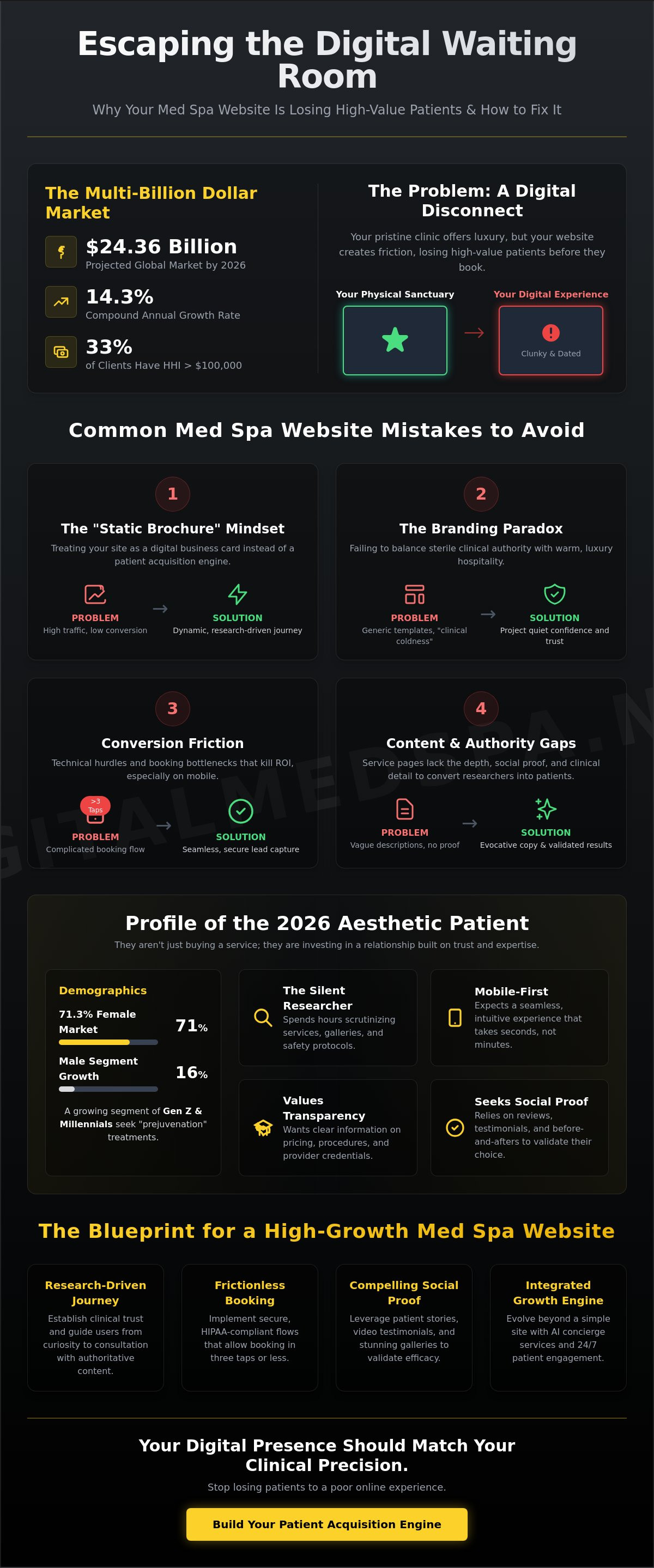
The definition of what a medical spa is has transformed from a niche clinical offering into a $24.36 billion global powerhouse as of 2026. This rapid growth, moving at a compound annual rate of 14.3%, has fundamentally changed how patients interact with your brand online. In previous years, a simple website served as a digital business card. Today, that approach is a liability. One of the most common med spa website mistakes to avoid is treating your site as a static brochure rather than a dynamic, high-performance patient acquisition engine.
Modern patients are more sophisticated and skeptical than ever. They don't just stumble upon your practice; they embark on a research-heavy journey that is almost exclusively mobile-first. With 33% of med spa clients reporting a household income of over $100,000, your digital presence must reflect the precision and luxury they expect. If your website feels dated or lacks clinical depth, you're not just losing a click; you're losing a high-value relationship before it even begins. The transition from providing information to facilitating a luxury experience is essential for capturing the 2026 market.
The Psychology of the Modern Aesthetic Patient
The 2026 patient is often a "silent researcher." They may spend hours navigating your service pages, scrutinizing before-and-after galleries, and reading safety protocols before they ever consider booking a consultation. This demographic, particularly the growing segment of Gen Z and Millennials seeking "prejuvenation" treatments, values transparency and immediate gratification. Visual storytelling is no longer optional. It is the primary vehicle for communicating clinical safety and the promise of natural-looking results. If your booking process requires more than three taps on a mobile device, you've likely already lost their interest.
Measuring Website Success Beyond Traffic
High traffic numbers are often a vanity metric that masks underlying performance issues. In a world where the average patient spends $536 per visit, the true measure of success is your conversion rate for high-value procedures. Consider these factors when evaluating your site's efficacy:
Micro-Conversions: Are users downloading your guide on the latest 2026 FDA-approved injectables like Relfydess or Evolysse Sculpt?
Lead Quality: Is your site attracting the 71.32% of the market that identifies as female, or is it successfully tapping into the male segment growing at nearly 16%?
The Cost of Friction: Even a 1% decrease in your conversion rate can result in thousands of dollars in lost revenue for premium services.
By shifting your focus from "hits" to high-value lead acquisition, you transform your website into a bespoke concierge that works 24/7 to grow your practice.
The Branding Paradox: Failing to Balance Clinical Authority with Luxury Hospitality
Creating a digital home for your practice requires a delicate equilibrium between two seemingly opposing worlds: the sterile precision of medical science and the warm indulgence of high-end hospitality. Many practitioners fall into the trap of leaning too far in one direction. Among the common med spa website mistakes to avoid is the use of generic, "out-of-the-box" templates that signal a discount experience rather than a bespoke medical journey. If your website looks identical to a neighborhood salon, you're inadvertently devaluing the clinical expertise and safety protocols that justify your premium pricing.
Conversely, some sites over-emphasize clinical "coldness." While medical efficacy is paramount, a website that feels like a surgical textbook can alienate patients seeking a rejuvenating retreat. The goal is to project quiet confidence. You want your clients to feel safe in expert hands while simultaneously feeling excited about their aesthetic evolution. Hiding your providers behind stock photography is a critical error. In an era where 33% of clients have household incomes exceeding $100,000, these discerning individuals seek a personal connection with the medical professionals who will be performing their treatments. Inauthenticity kills conversions.
The Danger of Stock Imagery in 2026
By 2026, the proliferation of AI-generated and generic stock imagery has made patients hyper-aware of digital inauthenticity. Using "perfect" models who have never stepped foot in your clinic erodes trust in your actual aesthetic results. Authentic, high-resolution "Before and After" galleries are the lifeblood of a high-performance site. These images must be presented with clinical precision, showing consistent lighting and angles to prove genuine efficacy. Custom videography that showcases your team's technique further reinforces this transparency. For more insights on building a site that balances these elements, you might explore how bespoke digital strategy can elevate your brand's authority.
Crafting a Bespoke Value Proposition
Your value proposition should transcend mere service listings. Moving beyond "We offer Botox" to messaging like "We restore natural radiance through advanced neuromodulators" shifts the focus from the product to the outcome. This approach aligns with the FTC's Health Products Compliance Guidance, which requires that all health-related claims be truthful, non-misleading, and backed by scientific evidence. Differentiating your practice in a saturated market requires a digital voice that matches the physical experience of your spa. When your website uses luminous, evocative language paired with technical medical terminology, you create a sense of empowerment. This duality ensures that your safety protocols are never overshadowed by beauty, yet always presented through a lens of premium refinement.
Conversion Friction: Technical Hurdles and Booking Bottlenecks That Kill ROI
A visually stunning website serves little purpose if the technical infrastructure behind it is fractured. Identifying these common med spa website mistakes to avoid is the first step toward reclaiming your marketing ROI and ensuring your digital presence matches the precision of your clinical work. When a patient decides to pursue a treatment, any friction in the booking process acts as a deterrent, often leading to "analysis paralysis" or abandonment. A high-performance site must act as a seamless concierge, guiding the visitor from initial curiosity to a confirmed consultation with quiet confidence.
The "Three-Click Rule" is the gold standard for modern aesthetic practices. From the moment a prospective patient lands on your homepage, they should be no more than three interactions away from securing their appointment. Clunky, multi-step booking flows that require excessive data entry before providing a calendar view are significant conversion killers. By streamlining these digital touchpoints, you respect the patient's time and reinforce the premium nature of your brand.
Optimizing the Booking Workflow for 2026
Securing your schedule in 2026 requires more than just a contact form. Integrating seamless prepayments or deposits directly into your booking flow is essential for reducing no-shows and qualifying high-intent patients. This process should feel like a natural extension of your hospitality. Consider these technical enhancements to refine the journey:
One-Touch Integration: Incorporate Apple Pay and Google Pay to allow patients to secure their consultations instantly without searching for a credit card.
Automated Pre-qualification: Use intelligent forms to gather essential clinical history or skin concerns, ensuring the patient feels seen and understood before they even enter your spa.
SMS Connectivity: Transition from email-only confirmations to two-way SMS, providing the immediate gratification and ease of communication that modern luxury consumers expect.
The Technical Foundation: Speed, Security, and Compliance
High-end patients value their time as much as their results. A load time exceeding 3 seconds is often the catalyst for high bounce rates, particularly on mobile devices where the majority of aesthetic research occurs. Beyond speed, your technical foundation must be built on a bedrock of security. Failing to implement secure, encrypted forms is a liability that extends beyond mere user experience. Adhering to the HIPAA Privacy Rule for marketing is non-negotiable. This ensures that every patient interaction, from a simple inquiry to the submission of a photo for a virtual consultation, is handled with the same clinical care as an in-person visit. Furthermore, ensuring ADA accessibility is a mandatory component of a sophisticated site, allowing every individual to explore your services with dignity and ease.
Content and Authority Gaps: Why Your Service Pages Aren't Converting
A service page should be more than a clinical menu; it must be a persuasive narrative that resolves doubt and inspires confidence. One of the most common med spa website mistakes to avoid is providing vague service descriptions that fail to address the specific anxieties or objections of a prospective patient. In a market where facial treatments account for 52.18% of the total market share, simply stating you offer "facials" is insufficient. You must articulate the precision of your technique, the efficacy of your curated products, and the specific safety protocols that ensure a luminous, natural-looking result.
High-value patients are often willing to invest in premium services, but they require education on the "why" behind your pricing structure. Failing to justify your costs through the lens of medical expertise, advanced technology, and personalized care is a missed opportunity for conversion. By building "Service Pillar" pages, you create a hub of authority that dominates search rankings while simultaneously nurturing patient trust through detailed, science-backed explanations. This approach transforms a simple list of procedures into a testament to your practice’s clinical excellence.
The High-Value Service Framework
Structuring pages for complex, high-intent treatments like Semaglutide for weight management or biostimulators for regenerative aesthetics requires a delicate balance of medical depth and lifestyle appeal. These pages should integrate clinical studies and safety documentation, especially following the 2025 MoCRA compliance deadlines for facility registration and product listings. A result-first content strategy prioritizes the visual and emotional transformation of the patient, using clinical evidence to validate the journey toward their aesthetic goals. This ensures your messaging remains professional yet deeply personal, striking the right chord with the modern researcher.
Strategic Integration of Social Proof
Social proof is most effective when it appears at the exact moment of decision-making. Placing contextual reviews directly beneath a booking button provides the final reassurance a skeptical researcher needs to take the next step. Video testimonials offer a unique emotional resonance, allowing prospective clients to see the quiet confidence and radiance your practice provides to others. To further establish instant authority, showcase your professional certifications and "As Seen In" badges that signal your position at the forefront of modern aesthetics. If you're ready to refine your digital presence and close these authority gaps, you can partner with experts in aesthetic growth to elevate your brand's online performance.
Beyond the Design: Integrating a Holistic Growth Ecosystem
A final, pervasive error in the industry is viewing your digital presence as an isolated asset. Among the common med spa website mistakes to avoid, treating your site as a silo rather than the central hub of your marketing ecosystem is perhaps the most detrimental to long-term growth. In 2026, your website must serve as the primary engine that powers your social media, email campaigns, and in-office patient data. It is the place where clinical authority meets the luxury of a personalized patient journey, ensuring that every touchpoint feels intentional and refined.
Modern patient acquisition requires 24/7 engagement. High-value clients often research treatments late at night or during brief windows of personal time. Implementing AI-concierge services allows your practice to offer immediate, sophisticated support without overwhelming your front-desk staff. This technology provides a guiding hand, answering technical questions about safety protocols or efficacy while maintaining the upscale tone of your brand. Digital Med Spa's custom website design approach specifically addresses these pitfalls by creating a high-performance engine that automates the transition from curious researcher to loyal patient.
The Role of AI and Personalization in 2026
The 2026 roadmap for success is paved with deep personalization. Interactive skin analysis tools now serve as powerful lead magnets, offering patients a bespoke preview of their aesthetic potential. These tools, paired with personalized patient portals, allow for seamless post-treatment care and tailored recommendations that enhance lifetime value. Dynamic content that shifts based on a visitor's previous interests ensures that a client looking for "prejuvenation" skin boosters doesn't see the same messaging as one interested in mid-face volume restoration. This level of intentionality transforms a generic visit into a luminous, curated experience.
Choosing the Right Partner for Your Digital Transformation
Generalist agencies often struggle to navigate the intricate nuances of med spa marketing, particularly the balance between medical precision and high-end hospitality. You require a partner who understands the clinical complexities of new 2026 approvals like Obagi saypha MagIQ and the legal landscape of ownership regulations. Auditing your current site for these 10 critical mistakes is the first step toward clinical excellence. By harmonizing advanced technology with the quiet confidence of expert care, you can ensure your practice remains at the forefront of the modern aesthetic industry.
Refining Your Digital Sanctuary for the 2026 Patient
Transforming your online presence from a static display into a high-performance patient acquisition engine is essential for capturing a share of the $24.36 billion market projected for 2026. You've explored how to balance clinical precision with the warmth of luxury hospitality while eliminating the technical friction that leads to lost appointments. By addressing these common med spa website mistakes to avoid, you ensure your practice reflects the same radiance you provide in your treatment rooms. Your digital home must be a place where science meets beauty, offering a guiding hand to every prospective patient during their aesthetic journey.
Your website should be the luminous heart of your marketing ecosystem, not a silo that hinders your growth. Digital Med Spa specializes in high-performance aesthetic marketing that harmonizes clinical authority with bespoke luxury design through our proprietary patient acquisition frameworks. It's time to Audit Your Aesthetic Practice Website with Digital Med Spa to discover how to rejuvenate your digital journey. The path to a seamless, automated patient experience is within your reach; we're here to help you lead the way in modern aesthetics with quiet confidence and expert care.
Frequently Asked Questions
What is the most common mistake on med spa websites?
Treating a website as a static digital brochure rather than a dynamic conversion engine is the most frequent error. This is one of the common med spa website mistakes to avoid because it fails to engage the 71.32% of patients who now initiate their aesthetic journey through online research. A high-performance site must facilitate a luxury experience through interactive elements and intuitive navigation to capture modern interest.
How often should a medical spa update its website design?
You should refresh your digital presence every 24 to 36 months to maintain clinical relevance and technological precision. With the global medical spa market growing at a compound annual rate of 14.3%, patient expectations for mobile speed and AI integration evolve rapidly. A dated design can inadvertently signal a lack of innovation to clients seeking the latest 2026 approvals like Relfydess or Evolysse Sculpt.
Does my med spa website really need to be HIPAA compliant?
Yes, HIPAA compliance is mandatory for any website that collects protected health information through contact forms, portals, or consultation requests. The U.S. Department of Health and Human Services (HHS) enforces strict protocols for data security in marketing. Failing to meet these standards compromises patient trust and exposes your practice to significant legal liability and regulatory scrutiny.
Why is my med spa's 'Before and After' gallery not loading correctly on mobile?
Slow loading speeds are typically caused by unoptimized, high-resolution images that exceed the 3-second maximum threshold luxury consumers expect. Since facial treatments account for 52.18% of the market share, your gallery is often the most visited section of your site. Ensuring these images are formatted for mobile-first delivery is critical for demonstrating the clinical efficacy of your work without frustrating the user.
Can a bad website design hurt my med spa's SEO rankings?
Poor design negatively impacts SEO by increasing bounce rates and reducing the time visitors spend on your pages. Search engines prioritize sites that offer a seamless mobile experience and clear, structured data. A clunky or confusing interface is a common med spa website mistake to avoid if you want to maintain visibility and rank for high-intent keywords in a competitive 2026 landscape.
What are the essential features of a high-converting med spa booking system?
A high-converting system must offer a "Three-Click Rule" journey that includes integrated prepayments and automated pre-qualification forms. It should also utilize one-touch SMS confirmations and Apple Pay or Google Pay options. These features cater to the 33% of clients with household incomes over $100,000 who value their time as much as their aesthetic results.
Should I include pricing for my aesthetic treatments on my website?
Providing price ranges or "starting at" values establishes transparency and qualifies your leads before they reach your clinical staff. While the average patient spend is $536 per visit, clear communication about the investment required for bespoke care helps justify your premium pricing. This approach reduces time spent on unqualified consultations and reinforces your position as a trusted medical authority.
How can I make my medical spa website look more luxury and less clinical?
Harmonize technical medical terminology with evocative lifestyle language to create a sophisticated "Clinical-Luxury" brand identity. Use high-quality, custom videography and a refined color palette that reflects the tranquility of your physical sanctuary. This duality ensures your medical expertise is presented through a lens of premium hospitality, making patients feel both safe and excited about their rejuvenation.


Comments