
HIPAA Compliant Social Media Marketing: The 2026 Strategy for Aesthetic Practices
- Devon Kirk

- Apr 29
- 12 min read
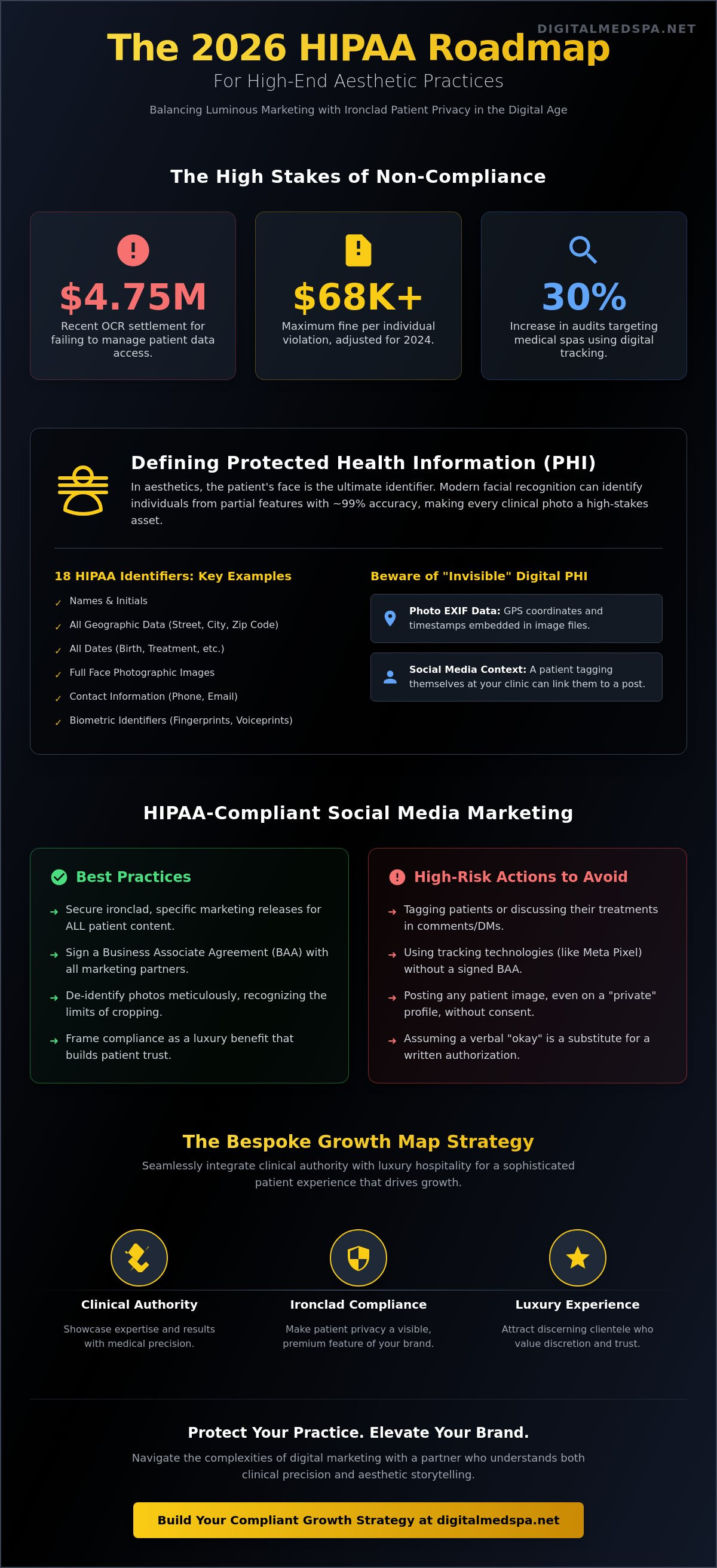
In 2024, the Office for Civil Rights (OCR) finalized a 4.75 million dollar settlement against a health system for failing to manage access to patient data, a stark reminder that digital oversight carries a heavy price. You likely recognize that showcasing luminous skin and bespoke transformations is essential for your growth; however, the haunting possibility of a six-figure fine for a misplaced photo often creates a paralyzing hesitation. It's frustrating to feel like your clinical excellence is hidden behind a wall of regulatory fear.
We'll help you master the delicate balance of HIPAA compliant social media marketing to grow your practice without compromising patient trust. You will learn how to secure ironclad marketing releases and identify exactly which pixels in a photo constitute Protected Health Information (PHI). This guide provides a 2026 roadmap for high-end content that protects your medical license while attracting the sophisticated clientele you deserve. We'll explore the intersection of clinical precision and aesthetic storytelling, ensuring your digital presence is as refined as your results.
Key Takeaways
Understand why aesthetic practices are high-priority audit targets and how to balance clinical precision with the radiant visibility of your brand.
Master the art of HIPAA compliant social media marketing by implementing bespoke authorization protocols for every before-and-after transformation you share.
Learn to identify the 18 markers of Protected Health Information, recognizing why a patient’s face is the ultimate identifier in modern aesthetic marketing.
Navigate the complex 2026 landscape of Meta Pixels and learn why a Business Associate Agreement is a non-negotiable requirement for your marketing partnerships.
Discover the "Bespoke Growth Map" strategy to seamlessly integrate clinical authority with luxury hospitality for a more sophisticated patient experience.
Table of Contents The Intersection of Clinical Privacy and Aesthetic Visibility Defining PHI in the Modern Med Spa Landscape Navigating High-Risk Content: Before-and-Afters and Testimonials Technical Safeguards for 2026: Pixels and BAAs Partnering for Growth: Sophisticated Marketing Without Compromise
The Intersection of Clinical Privacy and Aesthetic Visibility
As we enter 2026, the Department of Health and Human Services (HHS) has intensified its focus on the aesthetic industry. Recent data from the Office for Civil Rights (OCR) indicates a 30% increase in audits specifically targeting medical spas that utilize advanced digital tracking. For the modern practitioner, achieving HIPAA compliant social media marketing is no longer a backend administrative task. It's a front-facing pillar of your brand's integrity. You must balance the luminous radiance of your patient results with the clinical precision required by law.
General marketing advice often fails medical spa owners because it prioritizes engagement at the expense of privacy. A standard influencer strategy might suggest tagging clients or responding to comments with specific treatment details, but these actions create immediate liability. The Health Insurance Portability and Accountability Act (HIPAA) remains the foundational standard for protecting sensitive patient data, yet its application in the era of high-definition video and viral trends has become increasingly complex.
The cost of a mistake is heavy. Beyond the financial penalties, which reached a 2024 adjusted maximum of over $68,000 per individual violation, there's the risk of reputational erosion. Discerning patients expect a bespoke experience that guards their anonymity. A single privacy breach can dissolve the trust you've spent years building, turning a sanctuary of wellness into a source of public scrutiny.
The Evolution of HIPAA in the Social Era
Social media algorithms and the nature of digital "shares" complicate the definition of disclosure. When a patient's before-and-after photo is shared into a new network, the practice often loses control over the context of that data. We've moved from a period of accidental violations, such as an unblurred chart in the background of a selfie, to systemic scrutiny of tracking technologies. Meta Pixels and similar analytics tools that identify potential patients are now primary targets for federal investigators. It's also vital to remember that your personal profile isn't a safe haven. Posting a "work win" featuring a recognizable client on a private Instagram account still constitutes a breach if proper authorizations aren't documented.
Empowering Your Practice Through Compliance
Safety is luxury. It's the silent promise that a patient's transformation remains their own story to tell, shared only when they choose. By reframing HIPAA compliant social media marketing as a premium benefit, you attract high-value patients who prioritize discretion. There's a profound psychological link between medical safety and aesthetic trust. When a client sees that you handle their data with clinical efficacy, they feel more confident in the precision of your syringes and lasers. This compliance-first culture ensures that the medical nature of your business is never overshadowed by the pursuit of likes, maintaining a polished and refined brand presence that resonates with a sophisticated audience.
Defining PHI in the Modern Med Spa Landscape
Protected Health Information (PHI) constitutes any individually identifiable health data, including the 18 specific identifiers defined by federal law, that can link a patient's identity to their past, present, or future medical care or payment history. In the aesthetic industry, the most prominent identifier is the patient's face. While many practitioners believe that cropping a photo to show only a jawline or a set of lips provides anonymity, modern facial recognition technology can now identify individuals from partial features with approximately 99% accuracy. This biological fingerprint makes every clinical photo a high-stakes asset that requires meticulous handling to maintain HIPAA compliant social media marketing standards.
Beyond the visible image, "invisible" PHI often hides within the digital architecture of your posts. Every photo captured on a smartphone contains EXIF data, which can include the exact GPS coordinates of your clinic and the precise second the image was created. If a patient tags themselves at your location at the same time you post their "Before" photo, the metadata creates a digital bridge that confirms their status as a patient. To understand the full scope of these protections, practitioners should consult the official HIPAA Privacy Rule summary provided by the Department of Health and Human Services.
Engagement on social platforms also carries clinical weight. When a follower leaves a comment describing their recovery or asks for advice regarding a specific side effect, that public thread effectively transforms into a medical record. Acknowledging the patient's treatment status in a public forum, even with a friendly "We loved seeing you today," constitutes a disclosure of PHI. It's a delicate balance to maintain a warm, welcoming presence while strictly guarding the privacy that defines a premium medical experience.
The 18 Identifiers: A Med Spa Checklist
Common pitfalls in aesthetic marketing often involve "comparable identifiers" that go beyond names and social security numbers. Unique tattoos, distinctive birthmarks, or even a rare piece of jewelry can lead to re-identification. A 2019 study published in Nature Communications demonstrated that 99.98% of individuals could be correctly re-identified in any dataset using only 15 demographic attributes. This means that a "de-identified" caption describing a "34-year-old teacher from the local Heights neighborhood" may provide enough context for the community to identify the patient, leading to a significant privacy breach.
DMs and Engagement: When Conversations Become Clinical
Direct Messages often feel informal, yet they're a primary site for HIPAA violations. When a patient sends a photo of their post-injection bruising via Instagram DM, they're seeking clinical reassurance. Your response must never confirm their identity or treatment details on an unencrypted platform. Establishing a protocol to move these inquiries to secure, encrypted patient portals ensures that your practice remains a sanctuary of safety. Refining these digital boundaries allows you to focus on delivering bespoke aesthetic results while maintaining total professional discretion. Always redirect clinical questions to a secure channel to ensure every interaction remains protected and professional.
Navigating High-Risk Content: Before-and-Afters and Testimonials
Aesthetic transformations represent the pinnacle of your clinical skill, yet they also carry the highest risk for privacy violations. The Golden Rule of HIPAA compliant social media marketing is that silence is never consent. You cannot rely on a patient's verbal approval or a casual "feel free to post this" text message. Every piece of visual content that identifies a patient, even through unique features like tattoos or birthmarks, qualifies as Protected Health Information (PHI).
According to the HHS Guidance on HIPAA Marketing Rules, any use of PHI for promotional purposes requires a specific, written authorization that's separate from your standard Notice of Privacy Practices. This document must be transparent about where the content will live and who will see it. Maintaining clinical dignity means your content should celebrate the patient's radiance without compromising their legal protections. It's about building a bridge of trust between medical precision and lifestyle aspiration.
The Anatomy of a Valid Marketing Authorization
A legally sound release form isn't a one-size-fits-all template. To stand up to scrutiny in 2026, it must include a specific expiration date, typically 24 or 36 months from the date of signature. It needs to clearly state that the patient has the "Right to Revoke" their consent at any time. If a patient changes their mind, you're required to remove the content from all active social feeds within a reasonable timeframe, often 15 days or less. Integrating these digital consent forms directly into your med spa website design ensures that the paperwork is as seamless as the patient experience itself. Digital signatures provide a clear audit trail, replacing the liability of messy, physical filing systems.
Handling Social Proof and Reviews
Public reviews are the lifeblood of a modern practice, but they're a compliance minefield. When a patient leaves a glowing five-star review on Google or Facebook, your instinct is to "Like" or "Share" it. Don't. Engaging with a review in a way that confirms the person is a patient can be interpreted as a HIPAA violation. Even if they've shared their entire journey publicly, you must remain the silent, professional observer.
Never confirm patient status: Use neutral language like, "Thank you for the kind words about our team's expertise."
Avoid PHI in replies: Don't mention specific treatments, dates, or results in your response.
Direct the conversation: Encourage prospective clients to book a bespoke consultation rather than discussing details in a public comment thread.
By treating every digital interaction with the same precision you apply to a dermal filler injection, you protect your practice from the 10% of HIPAA complaints that now originate from social media activity. Your goal is to inspire confidence through luminous results while maintaining the ironclad safety protocols that define a premium medical brand.
Technical Safeguards for 2026: Pixels and BAAs
The 2026 landscape of tracking technology requires a surgical approach to data. The Meta Pixel controversy, which peaked following the 2022 HHS bulletins, has fundamentally changed how we manage HIPAA compliant social media marketing. Traditional browser-side pixels are now considered high-risk because they capture patient intent data indiscriminately. To maintain the efficacy of your campaigns, your practice must pivot to server-side tracking. This method acts as a sophisticated gateway, scrubbing Protected Health Information (PHI) before it ever reaches an advertising platform's servers. It ensures your marketing remains luminous and effective without exposing your patients' private health journeys.
Auditing your tech stack for leakage is a non-negotiable precision task. Data often slips through via auto-fill forms, URL parameters, or unmasked IP addresses. By implementing a privacy-first tracking layer, you gain the ability to filter out specific identifiers. This allows you to track conversions with clinical accuracy while keeping the patient's identity entirely secure within your internal systems.
The Role of the BAA in Aesthetic Growth
Your medical license is your most valuable asset, and a Business Associate Agreement (BAA) is its primary shield. A BAA isn't a mere formality; it's a legal contract that ensures your med spa marketing agency accepts shared responsibility for data protection. Many generalist agencies refuse to sign these documents because they lack the infrastructure to handle clinical liability. If an agency won't sign a BAA, they shouldn't have access to your patient data. A bespoke agreement should clearly define:
Specific protocols for handling and storing PHI.
Breach notification timelines that align with federal requirements.
Indemnification clauses that protect the practice owner's interests.
Clear definitions of the 18 HIPAA identifiers relevant to aesthetic leads.
First-Party Data: The Ultimate Compliance Asset
The most secure way to scale is to build a walled garden of patient data that you own and control. Relying on third-party tracking is increasingly precarious. Instead, we use med spa seo to drive high-intent traffic directly to secure, encrypted environments. Once a patient enters your ecosystem, their data remains within a HIPAA-compliant CRM rather than floating in a social media pixel's cloud. This strategy reduces your reliance on external tracking and creates a more intimate, personal connection with your audience. It's a transition from renting audiences to owning relationships, ensuring long-term practice stability and patient trust.
Ensuring your technical stack is airtight doesn't have to be a source of stress. It's an opportunity to demonstrate the same precision in your digital presence that you show in the treatment room. If you're ready to secure your practice's future, book a technical compliance audit with our team today.
Partnering for Growth: Sophisticated Marketing Without Compromise
The intersection of high-end aesthetics and rigorous patient privacy is where true practice growth thrives. Achieving HIPAA compliant social media marketing requires more than just avoiding patient names; it demands a holistic architecture that protects the provider and the patient alike. At Digital Med Spa, we believe your digital presence should reflect the same meticulous care you provide in the treatment room. We bridge the gap between clinical necessity and the luxury experience your patients expect.
The Digital Med Spa Difference
We don't just provide marketing services. We act as your clinical partner. Our team signs formal Business Associate Agreements (BAAs) with every client, ensuring that your data handling meets federal standards from day one. By integrating med spa advertising with advanced encryption and secure lead capture, we remove the friction between luxury growth and legal safety. You gain the freedom to showcase luminous results while we manage the technical complexities of data sovereignty. This expert-led approach provides the peace of mind necessary to focus on your craft.
A Future-Proof Aesthetic Practice
Compliance isn't a checkbox you mark once. It's an ongoing commitment to excellence that evolves as technology shifts. As HHS continues to refine regulations around tracking pixels and third-party cookies, your strategy must remain proactive. We develop a Bespoke Growth Map for each practice, ensuring that your HIPAA compliant social media marketing strategy scales as you do. Our framework includes:
Continuous monitoring of tracking technologies to prevent unauthorized data transmission.
Bespoke content strategies that emphasize natural results without compromising PHI.
Scalable systems designed to support expansion to multiple locations without multiplying your legal risk.
Regular audits that align with the latest 2026 privacy standards.
Your journey toward a more secure, sophisticated presence begins with a clear understanding of your current vulnerabilities. Recent industry audits suggest that up to 85 percent of common tracking tools may inadvertently share protected health information if not configured correctly. We invite you to schedule a bespoke consultation to review your current marketing compliance. Together, we'll audit your social presence and design a path forward that celebrates natural beauty with absolute clinical precision.
Elevating Your Practice with Clinical Precision and Digital Refinement
The evolution of digital aesthetics in 2026 demands a sophisticated fusion of luminous branding and unwavering patient privacy. Success doesn't rest solely on the visual allure of a transformation gallery. Instead, it requires the meticulous implementation of technical safeguards like pixel management and secure data handling. By mastering HIPAA compliant social media marketing, your practice ensures that every digital touchpoint reflects both clinical excellence and high end hospitality. Since 2018, Digital Med Spa has refined the art of scaling aesthetic practices through full BAA compliant agency protocols and high authority med spa marketing. You deserve a partner who understands that your reputation is built on both your clinical precision and your commitment to patient confidentiality. This balance creates a foundation of trust that allows your natural results to shine without legal compromise. Ready to scale your practice with clinical precision and luxury flair? Schedule your Bespoke Marketing Audit with Digital Med Spa today. Your journey toward a more radiant and secure digital presence begins with a single, intentional step.
Frequently Asked Questions
Can I post a patient's before-and-after photo if their eyes are covered?
No, you can't post a photo with obscured eyes without a signed HIPAA marketing authorization form. The Safe Harbor method requires the removal of 18 specific identifiers, but unique features like tattoos or distinct facial contours can still identify an individual. In 2026, advanced facial recognition can often identify patients from partial images, making a formal written release the only way to safeguard your clinical reputation.
Is it a HIPAA violation to reply to a patient's comment on my Instagram post?
Replying to a comment is a violation if your response confirms the individual is a patient or discloses their treatment details. Even a warm "It was a pleasure seeing you!" confirms a provider-patient relationship in a public forum. You should keep public interactions general and professional; always invite the individual to a secure, private channel to discuss their bespoke treatment plan or specific aesthetic concerns.
Does my med spa need a BAA with Facebook or Instagram?
Meta doesn't sign Business Associate Agreements for standard social media profiles or their advertising platforms. This means these platforms aren't secure environments for transmitting or storing protected health information. To maintain HIPAA compliant social media marketing, you must ensure no patient data is stored within the platform's messaging tools, as the legal responsibility for data privacy rests entirely with your practice.
What should I do if a patient tags my practice in their own story?
Don't share a patient's story to your practice's official feed unless you have a signed marketing authorization on file. While patients have the right to share their own journeys, your act of resharing constitutes a formal disclosure of their patient status. A 2024 industry report indicated that unauthorized resharing is a leading cause of privacy complaints, so it's best to simply "like" the post instead.
Can I use 're-marketing' ads for patients who have visited my website?
You must proceed with extreme caution because using tracking pixels for re-marketing is strictly regulated under the HHS guidance updated in March 2024. You can't use identifying data to target ads to individuals based on their interest in specific medical procedures without explicit consent. Most elite practices now utilize privacy-first data strategies to ensure their HIPAA compliant social media marketing remains within these evolving federal boundaries.
Is it safe to use AI tools for generating social media captions for my med spa?
AI tools are safe for generating creative content as long as you never input specific patient names, treatment dates, or unique medical histories into the prompt. Most consumer-grade AI platforms don't offer BAAs and may use your data for model training. If your practice uses AI for personalized patient communication, ensure the software provider signed a BAA before 2026 to protect the precision of your privacy protocols.
What is the penalty for a social media HIPAA violation in 2026?
Penalties in 2026 follow a tiered structure adjusted for inflation by the Department of Health and Human Services. A "Willful Neglect" violation that isn't corrected can result in a minimum fine of $71,162 per individual record exposed. For systemic failures, the annual penalty cap for a single violation type can exceed $2,134,800, making a meticulous compliance strategy essential for the safety and longevity of your aesthetic brand.


Comments