
Key Performance Indicators for Med Spa Growth: The 2026 Precision Guide

If your clinic's labor costs are reaching the 2026 benchmark of 50% of revenue, your path to a 35% EBITDA margin depends entirely on surgical-level data precision. You likely feel the weight of rising overhead and the quiet sting of patient churn after a single, beautiful treatment. It's frustrating to manage a bustling waiting room only to realize your marketing ROI remains a mystery. Mastering the key performance indicators for med spa growth isn't just about spreadsheets; it's the foundation of a high-authority brand that balances medical efficacy with premium profitability.
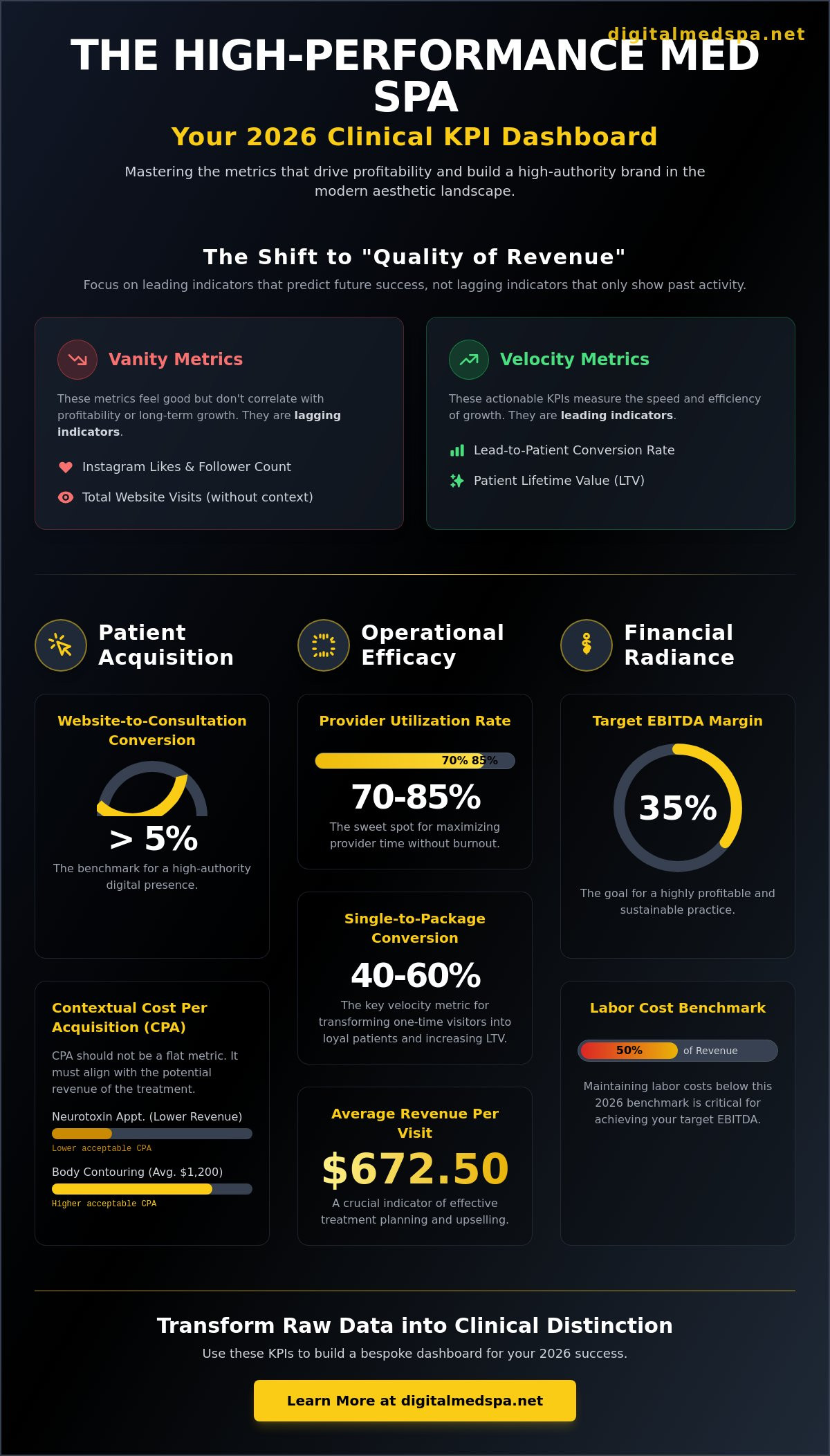
We'll show you exactly how to transform your practice into a high-performance sanctuary. This guide provides the clinical benchmarks you need, from achieving a target average revenue per visit of $672.50 to maintaining a healthy 70% to 85% provider utilization rate. You'll learn to optimize your marketing spend and increase your clinic's valuation by focusing on the metrics that actually drive radiance and long-term retention. We're moving beyond simple revenue to help you build a bespoke dashboard for your 2026 success.
Key Takeaways
Learn why shifting your focus from vanity metrics to the "Quality of Revenue" is essential for maintaining clinical excellence in the 2026 market.
Discover how to benchmark your operational efficacy by tracking revenue per provider hour and treatment room utilization rates to ensure your clinic operates with luminous efficiency.
Master the key performance indicators for med spa growth that allow you to calculate precise Patient Lifetime Value and build a bespoke treatment plan strategy.
Implement a sophisticated Monthly Business Review (MBR) framework to transform raw data into a clear, high-authority dashboard for your practice.
Table of Contents
Beyond Vanity Metrics: Why KPIs Are the Pulse of Aesthetic Excellence in 2026
The Patient Acquisition Engine: Digital Marketing KPIs That Predict Growth
Operational Efficacy: Measuring Provider Performance and Patient Flow
Financial Radiance: Profitability Metrics That Secure Your Legacy
From Data to Distinction: Implementing Your KPI Strategy with Digital Med Spa
Beyond Vanity Metrics: Why KPIs Are the Pulse of Aesthetic Excellence in 2026
In the sophisticated environment of a modern aesthetic practice, managing by intuition is no longer sufficient. You must treat your business data with the same diagnostic precision you apply to a complex dermal filler treatment. A Performance indicator acts as the clinical vital sign of your practice health; it reveals the underlying truth beneath a busy schedule. Refining your understanding of key performance indicators for med spa growth allows you to move beyond superficial success and toward a high-authority brand identity.
The 2026 market has shifted its focus from total revenue to the concept of "Quality of Revenue." It's a common trap to assume that a high volume of patients equals a thriving business. However, if your labor costs are hovering at the 50% benchmark while your patient churn remains high, your practice is effectively running in place. We distinguish between lagging indicators, which tell the story of your past performance, and leading indicators, which predict your future trajectory. While total monthly revenue is a lagging metric, your rebooking rate is a leading one that signals long-term sustainability.
The Evolution of the Data-Driven Med Spa
Modern aesthetics now demands a level of precision that mirrors medical science. By May 2026, the industry has embraced predictive analytics to anticipate patient needs before they even book. Moving from a "gut feeling" to clinical certainty means using data to decide which services to promote and when to expand your team. This evolution ensures your business decisions are as bespoke and intentional as the treatment plans you create for your clients. Data isn't just noise; it's the rhythm of your clinic's heart.
Vanity vs. Velocity: What Actually Drives Growth
It is easy to be seduced by vanity metrics like Instagram likes or follower counts. While these numbers look luminous on a screen, they don't always translate to clinical authority or net profit. In 2026, the most successful owners focus on "Velocity" instead. This is the speed at which a new lead transforms into a loyal advocate for your brand. High-velocity growth happens when your key performance indicators for med spa growth show a 40% to 60% conversion rate from a single treatment to a multi-visit package. This transition from a one-time visitor to a long-term patient is what creates true financial radiance and secures your legacy in a competitive landscape.
The Patient Acquisition Engine: Digital Marketing KPIs That Predict Growth
Your marketing engine should function with the same refined elegance as your most advanced aesthetic device. Understanding the key performance indicators for med spa growth means looking beyond the surface of your website traffic to identify the specific behaviors that lead to a clinical consultation. In 2026, the most successful practices don't just generate leads; they curate a high-authority digital presence that attracts the right patient for the right treatment at the right cost. This requires a comprehensive guide to med spa KPIs to ensure your marketing spend translates into clinical reality.
Cost Per Acquisition (CPA) must be analyzed by treatment category rather than as a single, flat figure. For example, with body contouring treatments averaging $1,200 in 2026, you can afford a higher CPA than you would for a single neurotoxin appointment. We also track your "Digital Authority Score," which measures your dominance in local search results and Google Business Profile interactions. If your website-to-consultation conversion rate is below 5%, your digital hospitality may be lacking. Furthermore, your lead response time is critical. High-value aesthetic patients expect a personal touch within minutes; a delay of even a few hours can result in a lost opportunity to a more responsive competitor.
Measuring the Efficacy of Your Med Spa SEO
Organic visibility remains the cornerstone of long-term profitability. By implementing sophisticated med spa seo, you can capture high-intent search traffic for advanced procedures like Morpheus8 or Semaglutide. This strategy reduces your long-term CPA by building a foundation of trust that paid ads simply cannot replicate. We monitor your organic keyword growth to ensure your clinic remains the primary choice for patients seeking bespoke rejuvenation in your local market.
Paid Media and ROI Precision
Paid campaigns require a meticulous focus on Return on Ad Spend (ROAS). When architecting med spa advertising, we look past the "Cost Per Lead" to the "Consultation Show Rate." A lead is merely a possibility; a patient in the chair is a partnership. With a healthy industry no-show rate between 5% and 10%, any deviation suggests a fracture in your patient journey. If your current metrics feel opaque, a bespoke business consultation can help illuminate your path to growth.
Operational Efficacy: Measuring Provider Performance and Patient Flow
While your marketing engine brings the patient through the door, your operational efficacy determines if they become a lasting cornerstone of your practice's success. In 2026, measuring key performance indicators for med spa growth requires a deep dive into how your clinical hours are actually spent. Revenue per provider hour is a vital benchmark for this analysis; top-tier clinics currently see ranges between $500 and $1,200 per hour. This metric allows you to evaluate clinical efficiency without the distortion of total monthly volume. It ensures that every minute spent in the treatment room contributes to the financial radiance and sustainability of the brand.
Another essential metric is treatment cross-pollination. This measures the percentage of patients who receive multiple service types, such as combining neurotoxins with advanced skin rejuvenation or body contouring. High-performing clinics aim for a 40% to 60% conversion rate from a single service to a multi-visit treatment plan. This approach transitions the patient from a transactional mindset to a bespoke aesthetic journey. Finally, your consultation conversion rate should reflect your role as a trusted expert. It is about securing a commitment to a clinical outcome through education rather than using high-pressure sales tactics.
Optimizing the Treatment Room
Efficiency in the treatment room begins with a clear understanding of your current capacity. Staff Utilization is the ratio of booked hours to available clinical hours. A healthy utilization rate falls between 70% and 85%; dropping below 65% indicates you're underbooked, while exceeding 90% often leads to provider burnout. To maintain a target of 12 average visits per day, you must identify service bottlenecks that slow down room turnover. Every minute saved through streamlined protocols allows for more intentional patient care and increased clinical throughput.
Provider Productivity and Retention
Tracking individual provider performance helps you identify specific training opportunities and mentorship needs. We look closely at rebooking rates and the retail-to-service ratio to ensure patients are protecting their clinical investment at home. In 2026, a target of $80 in retail revenue per visit is a strong indicator of a provider's ability to offer comprehensive, professional care. By sharing these key performance indicators for med spa growth through transparent dashboards, you empower your staff. Bespoke incentives based on these metrics foster a culture of excellence and quiet confidence within your entire team.
Financial Radiance: Profitability Metrics That Secure Your Legacy
Financial health is the ultimate reflection of your clinic's clinical excellence and operational discipline. While previous sections focused on the patient journey and provider efficiency, we now examine the metrics that ensure your practice remains a high-authority brand for decades to come. Net Profit Margin stands as the definitive measure of your business sustainability. For mature and efficient med spas in 2026, EBITDA margins typically range between 20% and 35%. If your margins fall below this window despite high patient volume, you may be suffering from "Discount Drag," where excessive promotional pricing erodes the perceived value of your expertise and eats into your clinical precision.
To achieve true financial radiance, you must shift your focus from single-visit transactions to Patient Lifetime Value (LTV). This metric tracks the total revenue generated by a patient over a 12-month period, often revealing that a bespoke treatment plan is worth significantly more than the initial $450 to $540 average visit revenue. Monitoring your membership churn rate is equally vital. A healthy recurring revenue stream provides the predictable income necessary for future expansion, but a high churn rate suggests a fracture in the patient experience or a lack of perceived value in your long-term offerings.
The Science of Patient Retention
In the 2026 aesthetic landscape, retention is the most potent driver of profitability. Research from Bain & Company suggests that increasing patient retention by just 5% can boost profits by more than 25%. This is because the cost of keeping a loyal advocate is significantly lower than the cost of acquiring a new lead. We pay meticulous attention to the "Second Visit Conversion," which remains the most difficult hurdle in the industry. Typical retention rates currently sit between 50% and 70%, and your ability to exceed these benchmarks depends on how effectively your loyalty programs and follow-up protocols nurture the patient after their initial treatment.
Maximizing High-Margin Procedures
Your service mix should be a curated collection of treatments that balance clinical efficacy with high-margin returns. Analyzing which procedures offer the lowest overhead and highest provider efficiency allows you to optimize your schedule for maximum impact. A sophisticated med spa website design plays a critical role here by positioning your premium service tiers as the primary solution for discerning clients. By minimizing "dead time" in your laser suite and prioritizing high-margin treatments, you ensure your facility works as hard as your providers do. If you're ready to secure your practice's financial future, book a strategic business coaching session to refine your key performance indicators for med spa growth.
From Data to Distinction: Implementing Your KPI Strategy with Digital Med Spa
Transforming your clinical data into a narrative of success requires a transition from passive observation to active refinement. While we've discussed the importance of metrics like revenue per provider hour and patient lifetime value, the true power of key performance indicators for med spa growth lies in their implementation. A custom KPI dashboard should feel like a serene treatment room; it must be clean, organized, and focused only on the most vital information. We help owners avoid the "data fatigue" that often accompanies modern practice management by distilling complex spreadsheets into a clear, visual representation of clinical health.
The Monthly Business Review (MBR) framework serves as your practice’s diagnostic checkup. It’s a dedicated time to align your med spa marketing with your actual operational capacity. If your digital authority is driving a surge in body contouring leads, but your treatment rooms are already at an 85% utilization rate, your data tells you it’s time for expansion rather than increased ad spend. This level of intentionality ensures your growth is steady, predictable, and never compromises the patient experience. By April 2026, the most successful clinics will be those that treat their data with the same care as their clients.
The Digital Med Spa Consulting Approach
Our business coaching and consulting services bridge the gap between marketing data and operational reality. We don't just look at clicks; we look at clinical throughput. For practices aiming for a $10M+ valuation by the end of 2026, we develop bespoke strategies that prioritize scalability and profitability. Moving from reactive management to proactive scaling means knowing exactly which lever to pull when your rebooking rate dips or your CPA fluctuates. It's about building a legacy of excellence through precision and quiet confidence.
Your Next Step Toward Aesthetic Authority
Your journey toward becoming a high-performance brand begins with your digital foundation. A high-performance website serves as your primary data collector, capturing every interaction from the first search to the final booking. Partnering with a specialized medical practice marketing agency is no longer a luxury; it's a non-negotiable requirement for clinics that demand aesthetic authority. We invite you to a strategy audit to uncover the "hidden" growth metrics within your practice. Let's refine your key performance indicators for med spa growth and illuminate your path to distinction.
Architecting Your Path to Aesthetic Authority
The evolution of the aesthetic market in 2026 requires more than just clinical skill; it demands a meticulous mastery of your practice's vital signs. By shifting your focus from superficial vanity metrics to high-impact key performance indicators for med spa growth, you ensure every treatment and marketing dollar serves a greater purpose. Whether you're optimizing for a target average revenue per visit of $672.50 or striving for a 35% EBITDA margin, your success depends on the precision of your data. We've explored how operational efficacy and financial radiance create a foundation for long-term distinction in a competitive landscape.
You don't have to navigate this complex landscape alone. With our proven expertise in $10M+ practice scaling and clinical luxury brand positioning, we specialize in high-intent patient acquisition that transforms your digital presence into a high-performance engine. It's time to move beyond reactive management and embrace proactive, data-driven scaling that secures your legacy. Scale your practice with a data-driven Med Spa Strategy Audit and uncover the hidden potential within your clinic. Your journey toward becoming a high-authority brand starts with a single, intentional step.
Frequently Asked Questions
What is the single most important KPI for a growing med spa?
Revenue Per Provider Hour is the most critical metric because it measures the true efficiency of your clinical space and staff. Top-performing clinics in 2026 aim for a range between $500 and $1,200 per hour. This number tells you if your team is maximizing every minute in the treatment room. It's a far more accurate predictor of business health than total monthly revenue alone.
How often should I review my med spa's performance metrics?
You should review your operational vitals daily, while a comprehensive deep-dive should occur every month. We recommend a structured Monthly Business Review (MBR) to analyze your key performance indicators for med spa growth. This rhythm allows you to spot trends, such as a dip in your 50% to 70% patient retention rate, before they impact your long-term sustainability.
What is a healthy profit margin for a medical spa in 2026?
A healthy EBITDA margin for a mature, efficient medical spa typically sits between 20% and 35% in 2026. Achieving this requires meticulous control over labor costs, which can reach up to 50% of revenue in many practices. If your margins are lower, you may need to address "Discount Drag" or optimize your service mix to favor higher-margin procedures like body contouring.
How do I track my marketing ROI if patients call instead of booking online?
Implementing dynamic call tracking is the most precise way to bridge the gap between a phone call and a digital lead. By assigning unique numbers to different marketing channels, you can see exactly which SEO strategy or ad campaign prompted the dial. This data flows directly into your CRM. It allows you to track the patient's journey from their first inquiry to their final treatment.
What is the difference between Cost Per Lead and Cost Per Acquisition?
Cost Per Lead (CPL) measures the expense of acquiring a potential patient's contact information, while Cost Per Acquisition (CPA) is the total price paid to secure a paying patient. In 2026, a low CPL can be deceptive if those leads don't convert into consultations. You must focus on CPA to understand the true efficacy of your marketing spend across different treatment categories.
How can I improve my staff's rebooking rates without sounding pushy?
Frame the rebooking conversation as a necessary step in a bespoke clinical journey rather than a sales pitch. Your providers should explain that maintaining natural-looking results requires a consistent, science-backed schedule. When a rebooking is presented as a maintenance plan to protect the patient's initial investment, it feels like expert guidance. This approach naturally supports a healthy 70% to 85% utilization rate.
Is retail revenue really that important for med spa growth?
Retail revenue is essential because it provides a high-margin income stream that doesn't require additional provider time. The 2026 industry target for retail is approximately $80 per visit. Beyond the financial benefits, home-care protocols ensure the efficacy of the clinical procedures performed in your spa. It's a vital component of a comprehensive, high-authority patient experience that restores confidence.
How do I calculate Patient Lifetime Value (LTV) for my practice?
To calculate Patient Lifetime Value, multiply your average revenue per visit by the average number of visits per year, then multiply that by the average number of years a patient stays with your practice. For example, if your average revenue per visit is $672.50 and a patient visits four times annually for three years, their LTV is $8,070. This metric helps you determine how much you can sustainably spend on acquisition.


Comments