

Marketing for Medical Spa: The 2026 Strategy for Aesthetic Excellence

Updated: Mar 31
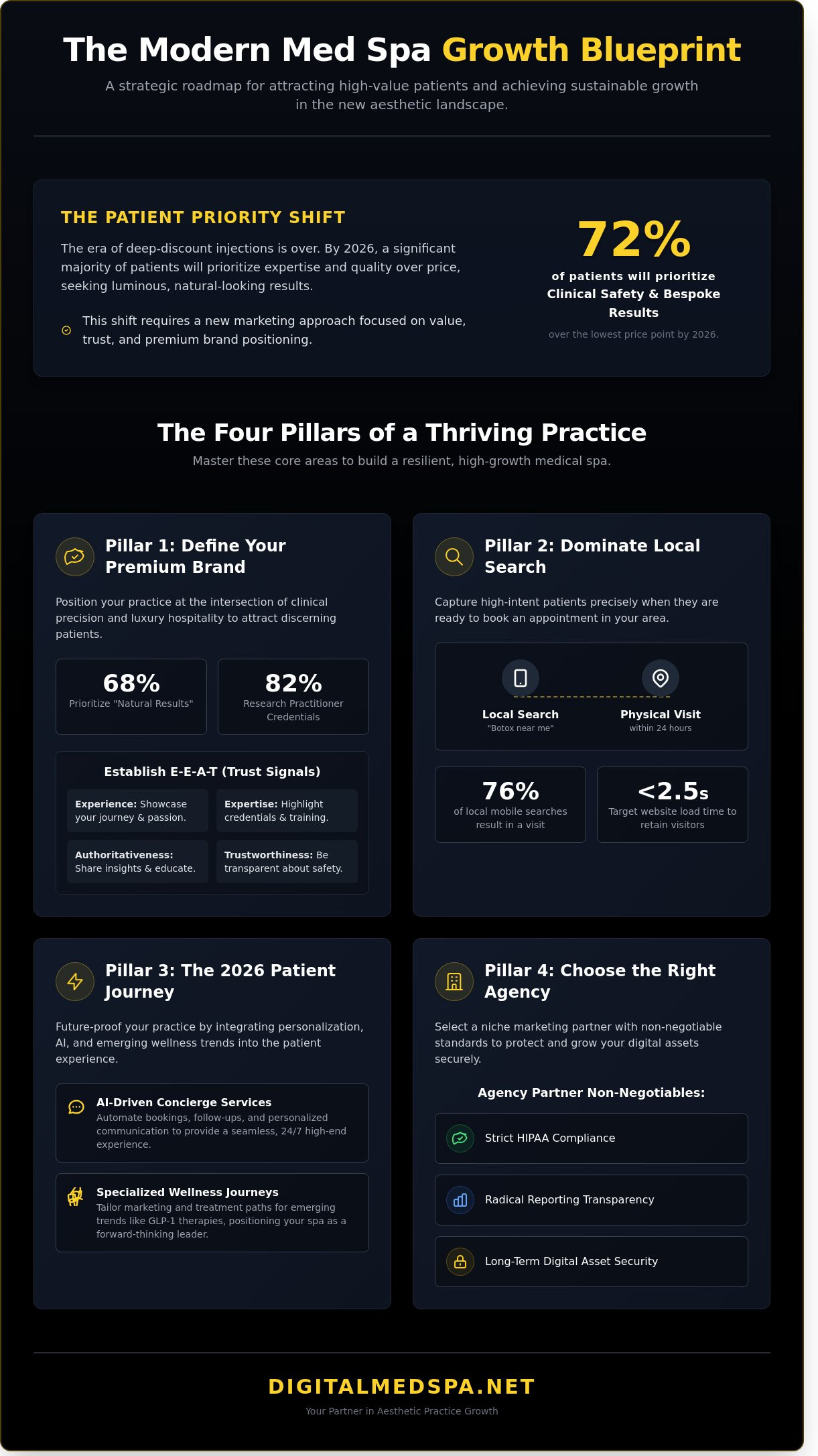
The era of the deep-discount injection is officially over; by 2026, 72% of aesthetic patients will prioritize clinical safety and bespoke results over the lowest price point. You’ve likely felt the frustration of a leaky lead funnel or the exhaustion of attracting bargain hunters who never return for a second treatment. Strategic marketing for medical spa growth requires a balance between technical precision and the warmth of high-end hospitality. You deserve a practice that reflects your meticulous expertise and attracts patients who value the luminous, natural-looking results you provide every day.
This article outlines a sophisticated roadmap to help you secure a 30% increase in patient retention through automated systems and premium brand positioning. You’ll discover the exact pillars needed to scale your practice while maintaining the quiet confidence that defines a leader in modern aesthetics. From auditing your ROI across search platforms to implementing bespoke patient journeys, we're setting a new standard for excellence that ensures your patient flow remains as consistent as your clinical results.
Key Takeaways
Learn how to position your brand at the intersection of clinical precision and bespoke hospitality to attract discerning patients seeking natural, luminous results.
Master the nuances of local SEO and high-intent keyword optimization to ensure your marketing for medical spa dominates search results in competitive regional markets.
Discover how to navigate the complex landscape of medical advertising by crafting compliant yet compelling ad copy that builds social authority and trust.
Prepare for the 2026 aesthetic landscape by integrating AI-driven concierge services and specialized patient journeys tailored to emerging wellness trends like GLP-1 therapies.
Identify the non-negotiable criteria for selecting a niche agency partner that prioritizes HIPAA compliance, reporting transparency, and the long-term security of your digital assets.
Table of Contents Defining Your Aesthetic Brand: Where Clinical Precision Meets Luxury Hospitality Dominating Local Search: SEO Strategies for High-Intent Patient Acquisition Beyond the Click: High-Performance Paid Advertising and Social Authority The 2026 Patient Journey: Integrating GLP-1 Trends and AI Personalization Navigating the Partnership: Choosing the Right Med Spa Marketing Agency
Defining Your Aesthetic Brand: Where Clinical Precision Meets Luxury Hospitality
Successful marketing for medical spa owners begins with a paradox; you must be as sterile as a surgical suite yet as inviting as a five-star resort. This duality creates the foundation for a brand that commands premium pricing without relying on heavy discounts. Since the history of medical spas began to diverge from traditional day spas in the late 1980s, the industry has struggled to find this equilibrium. Today, your brand identity shouldn't just promise beauty. It must promise a return to your client's best self. A 2023 industry report found that 68% of patients prioritize "natural results" over "lowest price" when selecting a provider. High-value clientele are repelled by the "overfilled" look that dominated the early 2010s. They want to look like they've had a long vacation, not a long appointment.
Effective marketing for medical spa success requires a psychological shift. You aren't selling a 30-minute Neurotoxin injection; you're offering a transformation of self-image. When a patient looks in the mirror and sees a refreshed version of themselves, they aren't calculating the cost per unit. They're valuing the restoration of their confidence. To ensure your brand reflects this, conduct a voice audit. Review your last 20 social media posts. If they feel like a digital flyer for a bargain basement, you're eroding your clinical authority. Your voice should be a curated mix of technical medical terminology and evocative lifestyle language.
Consider the following elements to refine your brand's authority:
Consistency: Your tone should be identical whether it's an Instagram caption or a post-care instruction sheet.
Elegance: Use vocabulary that reflects luxury, such as "bespoke," "radiance," and "luminous."
Clinical Authority: Never shy away from explaining the science. Use terms like "efficacy" and "cellular rejuvenation" to remind clients they're in a medical facility.
The "Science Meets Beauty" Visual Identity
Visuals dictate your perceived value before a client ever reads a treatment menu. Avoid stock photography featuring generic models with unrealistic features. Instead, use high-end, original photography that highlights skin texture and authentic radiance. Your color palette should balance tranquility and safety; think muted slate, soft champagne, or clinical whites paired with warm wood tones. The 2026 Modern Aesthetic brand persona is a hyper-personalized digital concierge that fuses regenerative biotechnology with an uncompromising ethos of quiet luxury.
Establishing E-E-A-T in the Aesthetic Space
Experience, Expertise, Authoritativeness, and Trustworthiness (E-E-A-T) are the pillars of medical marketing. A 2024 consumer survey revealed that 82% of patients research a practitioner's specific credentials before booking a consultation. Showcase these credentials prominently, but keep the tone personal. Don't just list degrees; explain the "why" behind your passion for aesthetics. Safety protocols shouldn't be hidden in fine print; they're a premium marketing feature. Use "behind-the-scenes" content to show your sterilization processes or the precision of your mapping techniques. This transparency builds a bridge of trust that traditional advertising can't replicate.
Dominating Local Search: SEO Strategies for High-Intent Patient Acquisition
Local SEO isn't just a digital checkbox; it's the most efficient engine for growth in competitive markets like Lexington and Columbia. When a potential patient searches for "Botox Lexington SC," they've moved past the awareness phase and are ready to book. In 2024, industry data indicates that 76% of localized mobile searches result in a physical visit within 24 hours. Effective marketing for medical spa practitioners requires capturing this high-intent traffic by optimizing for specific geographic and procedural intersections. This precision ensures your practice appears exactly when a client is seeking a bespoke aesthetic solution.
Your digital presence must reflect the precision of your clinical work. A website that takes longer than 2.5 seconds to load loses 40% of its visitors before they ever see your results. Mobile-first design is non-negotiable. Statistics from late 2023 show that 62% of aesthetic consultations begin on a smartphone during a lunch break or evening relaxation. Service pages should function as a bridge between clinical efficacy and aesthetic aspiration. Structure these pages with clear headings, detailed safety protocols, and realistic outcome descriptions to soothe a nervous patient's anxieties while satisfying Google's demand for authoritative content.
Google Business Profile: Your Digital Front Door
Choosing the correct primary category is vital for visibility. A practice specializing in injectables must prioritize "Medical Spa" over "Skin Care Clinic" to align with Google's local map algorithms. Your reputation management strategy needs to be proactive and meticulous. Respond to every review with professional grace, ensuring you adhere to FTC advertising guidelines regarding patient testimonials and health claims. Avoid making unsubstantiated promises about results. Instead, use GBP Posts twice weekly to showcase monthly specials or the arrival of new technology. This keeps your profile active and signals relevance to the search engine, helping you maintain a top-three position in the local map pack.
Content Strategy for Medical SEO
Modern marketing for medical spa success relies on answering the questions your patients are hesitant to ask in person. Targeting long-tail queries, such as "how to get more semaglutide patients" or "recovery time for microneedling," builds authority before the first consultation. Every blog post should serve as a supporting pillar. Use internal linking to guide readers toward your core treatment pages. This creates a cohesive web of information that helps search engines understand your expertise.
Focus on "near me" keywords for every major service category.
Include high-resolution, original imagery of your facility to build trust.
List specific zip codes in your footer to strengthen local relevance.
Ensure your Name, Address, and Phone (NAP) data is 100% consistent across the web.
For a deeper look at site architecture, you can explore our Med Spa SEO Pillar to refine your internal linking strategy. By addressing anxieties through educational content, you transform a cold lead into a confident patient. This approach prioritizes natural looking results and customized treatment plans, ensuring the medical nature of your business is presented through a lens of premium refinement. When you provide clear, science-backed answers, you establish a sense of tranquility before the patient even steps through your door.
Beyond the Click: High-Performance Paid Advertising and Social Authority
Precision in digital placement determines the success of your outreach. Google Ads captures high-intent searches from patients ready to book; Meta platforms build an aspirational narrative that cultivates long-term desire. Effective marketing for medical spa services requires a delicate balance between these two ecosystems. While one captures the "now," the other nurtures the "next."
Ad copy must be punchy yet compliant. Facebook and Instagram often restrict specific medical terms or "before and after" images that imply a negative self-image. To maintain a sophisticated presence, you should consult the FTC Health Products Compliance Guidance to ensure your claims are substantiated and transparent. Focus on the emotional and aesthetic outcome. Use evocative language like "restored volume" or "luminous complexion" to bypass rigid algorithmic filters while still speaking directly to the client's aspirations.
By 2026, the industry will fully pivot toward "Social Proof 2.0." This standard prioritizes unscripted video results over curated, high-production studio shots. A 2024 survey revealed that 68% of aesthetic clients feel more comfortable booking when they see a real person's journey; from the initial consultation to the final, natural-looking result. This raw transparency builds a bridge of trust that polished marketing simply cannot replicate.
Budgeting for growth requires a data-driven approach rather than guesswork. Most successful clinics aim for a Cost Per Acquisition (CPA) between $150 and $250 for high-ticket services like body contouring or advanced laser resurfacing. This ensures your marketing for medical spa efforts remain profitable. You should calculate your CPA by dividing your monthly ad spend by the number of confirmed, in-office consultations. If your average treatment value is $1,200, a $200 CPA provides a healthy 6x return on investment.
Google Ads for Immediate Patient Flow
Bidding on high-intent keywords like "coolsculpting near me" or "best lip filler Lexington SC" generates immediate leads. You must use bespoke landing pages for every ad group. Sending traffic to a generic homepage can result in a 35% drop in conversion efficiency. Tracking must move beyond simple clicks; you need to monitor actual booked consultations to understand your true return on ad spend.
Instagram and Facebook: Building the Luxury Lifestyle
Reels offer a canvas to demonstrate procedure safety and the "radiance" of a professional treatment. In markets like Lexington or Columbia, micro-influencer partnerships often outperform national celebrities. Local influencers with 5,000 to 15,000 followers typically see 4x higher engagement rates because their audience views them as a trusted neighbor. Use retargeting ads to stay top-of-mind for potential patients who viewed your service pages but didn't immediately book. This gentle persistence keeps your brand at the forefront of their aesthetic journey.
The 2026 Patient Journey: Integrating GLP-1 Trends and AI Personalization
The landscape of patient acquisition has evolved beyond simple visibility. By 2026, the most successful practices will treat the patient journey as a continuous, tech-enabled cycle rather than a series of isolated appointments. Effective marketing for medical spa owners now hinges on two pillars: the metabolic health boom and high-touch automation. It's no longer enough to offer a service; you must manage a transformation.
The GLP-1 Opportunity and Retention
The rise of Semaglutide and Tirzepatide has created a new demographic of aesthetic patients who require specialized care. These individuals aren't just looking for weight loss; they are seeking a total body restoration. A 2024 clinical survey revealed that 42% of patients on GLP-1 medications expressed concern over facial volume loss and skin laxity within the first six months of treatment. Your marketing must address this lifecycle immediately to capture this audience.
Success Roadmaps: Move away from selling single sessions. Design 12-month "Luminous Transformation" plans that bundle weight loss injections with Morpheus8 or body contouring treatments.
Educational Authority: Use your digital platforms to explain the science behind compounded formulas versus brand-name options. Clear, science-backed content builds the trust necessary for long-term retention.
Integrated Care: Market skin tightening treatments as a necessary partner to weight loss to ensure patients achieve their desired aesthetic results as their body changes.
AI and Automation in the Front Office
The modern patient expects immediate gratification and bespoke attention. AI-driven chatbots now serve as 24/7 concierges, handling complex inquiries about downtime, pricing, and pre-care instructions while your staff focuses on in-person luxury. These tools don't just answer questions; they capture intent and move leads through the funnel without manual intervention.
While AI excels at handling routine digital inquiries, many high-end practices also partner with specialized providers to ensure every phone call receives a professional, human response. In Europe, for example, services like ClicFone Télésecrétariat are essential for medical offices to manage patient communication seamlessly, ensuring no high-value client is ever lost to voicemail.
Sophisticated marketing for medical spa growth involves using predictive booking algorithms to maintain your schedule. If your data shows a patient typically requires a neurotoxin refresh every 105 days, your system should trigger a personalized SMS on day 90. This message shouldn't feel like a generic broadcast. It should feel like a thoughtful note from a dedicated coordinator who knows their history. Integrating your CRM with a unified marketing dashboard allows you to see a 360-degree view of your ROI, tracking a lead from their first AI interaction to their third membership payment.
Building a lifelong member requires more than a successful first treatment. It's about automating the "Next Step" before the patient even leaves the chair. When a one-time Botox patient checks out, your system should automatically enroll them in a personalized email sequence that highlights the benefits of medical-grade skincare or laser resurfacing tailored to their skin type. This transition from a one-time visitor to a committed member is what stabilizes your monthly recurring revenue and ensures long-term practice health.
Ready to modernize your patient experience? Explore how to
for sustainable growth.
Navigating the Partnership: Choosing the Right Med Spa Marketing Agency
Selecting a partner to oversee your digital footprint is a decision that carries significant weight for your clinical reputation. A generalist agency might manage a law firm or a construction company before turning their attention to your aesthetic practice. This lack of focus often leads to generic campaigns that fail to capture the high-end, clinical essence of your brand. Effective marketing for medical spa facilities requires a deep understanding of the patient journey, from the initial spark of interest to the final post-treatment follow-up. When an agency doesn't specialize, they often waste up to 30% of your ad budget on broad keywords that attract price-shoppers rather than loyal, long-term patients.
This isn't to say other industries lack precision. Specialized fields like virtual design for homebuilding, for example, require immense technical expertise—to see what this looks like in practice, check out CRAYDL. The key point is that your marketing partner must have deep knowledge of your specific industry.
The precision required in this industry is absolute. Your marketing partner must act as an extension of your medical team, respecting the boundaries of clinical ethics while projecting the luxury of a wellness retreat. This balance ensures that your practice attracts individuals who value efficacy and safety over the lowest possible price point.
Vetting for Clinical Understanding
A qualified agency should instinctively know that neurotoxins address dynamic wrinkles while dermal fillers restore lost volume. This distinction is vital for creating educational content that builds trust with a sophisticated audience. If an agency cannot explain the difference between a neuromodulator and a biostimulator, they cannot represent your expertise accurately. They must also navigate the strict landscape of HIPAA compliance and "Before and After" regulations, ensuring that every 2024 campaign adheres to patient privacy laws. The most overlooked clause in marketing contracts is asset ownership; if you don't own your website code and ad accounts, you're essentially renting your practice's digital identity rather than building equity in it.
Transparency in reporting is another non-negotiable factor. You should receive data that goes beyond "clicks" or "impressions" to show actual conversion rates and cost-per-acquisition for specific treatments. This level of detail allows you to see exactly how your marketing for medical spa services is contributing to your monthly revenue goals.
Ultimately, finding the right partner is about identifying a team that demonstrates a clear, data-driven approach to growth. For an international perspective on how top agencies structure their services, you can check out Digitalix.
The Digital Med Spa Difference
Digital Med Spa provides more than just aesthetic adjustments to your website. We combine bespoke design with business coaching to ensure your internal operations can handle the influx of new patients. Our 2023 data shows that practices utilizing this dual approach see a 28% higher retention rate compared to those focusing solely on lead generation. We focus on the "Total Patient Value," helping you move away from one-off discount seekers and toward clients who commit to comprehensive, multi-modality treatment plans.
Scaling Your Practice in South Carolina
Moving from a single-treatment room boutique to a multi-location enterprise requires a fundamental shift in your operational strategy. You must transition from founder-led marketing, where you're personally managing every social post or email blast, to a hands-off, agency-managed system. This evolution allows you to step back from the screen and focus on your role as a medical director or lead injector. By leveraging local market insights in Lexington and Columbia, we help you identify the specific demographics that drive growth in the South Carolina market.
Scaling requires systems that are repeatable and predictable. Whether you're expanding to a second location or adding three new treatment rooms to your existing space, your marketing must scale alongside your physical capacity. We provide the technical depth and luxury positioning needed to make that transition seamless. If you're ready to refine your approach and claim your place at the forefront of modern aesthetics, you can request a bespoke marketing audit from Digital Med Spa to begin your transformation.
Mastering the Future of Your Aesthetic Practice
The 2026 landscape requires a seamless fusion of clinical efficacy and bespoke luxury. Success hinges on integrating AI-driven personalization and responding thoughtfully to the GLP-1 wellness revolution. As your practice navigates these shifts, your digital presence must mirror the meticulous care you provide in the treatment room. Effective marketing for medical spa growth is no longer a static endeavor; it's a dynamic evolution that balances technical SEO precision with the warmth of high-end hospitality. You've built a reputation on safety and results, and your digital strategy should reflect that same level of excellence.
Since 2018, Digital Med Spa has specialized in crafting this balance through custom website design and expert SEO. We've refined our approach in competitive markets like Lexington and Columbia, SC, ensuring our partners achieve visibility that converts into long-term patient loyalty. Our comprehensive services include reputation management and business coaching to solidify your clinical authority. Elevate your practice with a bespoke marketing strategy from Digital Med Spa. Your journey toward a more luminous and sustainable future starts with a single, intentional step. We're ready to help you shine.
Frequently Asked Questions
How much should a medical spa spend on marketing in 2026?
You should allocate 10% to 15% of your gross annual revenue toward your marketing efforts to maintain a competitive edge. For a practice generating $1.2 million annually, this equates to a monthly investment of $10,000 to $15,000. High-growth clinics often increase this figure to 20% during their first 24 months. This consistent funding ensures your brand remains visible as digital landscapes become more crowded.
What is the most effective marketing for a new med spa?
Local search optimization and Google Business Profile management are the most effective strategies for a new practice. Focus on capturing the 46% of users who perform searches with local intent to find aesthetic services nearby. Successful marketing for medical spa startups relies on securing 25 to 30 authentic five-star reviews within the first 90 days. This social proof establishes the clinical authority needed to convert new visitors.
How do I get more patients for my med spa without using discounts?
Attract premium patients by highlighting bespoke treatment plans and exclusive membership tiers rather than lowering your prices. Data shows that well-structured membership programs increase patient lifetime value by 18% compared to one-off discounted appointments. Offer value-added benefits like a complimentary medical-grade serum with a $400 treatment. This approach preserves your brand's luxury status while rewarding the long-term commitment of your most loyal clients.
Is SEO or PPC better for medical spas in a competitive market?
SEO provides a 275% higher long-term return on investment than PPC in high-competition aesthetic markets. While PPC offers immediate visibility, 70% of sophisticated researchers bypass paid ads to click on organic, authoritative results. A balanced strategy uses PPC for short-term lead generation while building a permanent organic foundation. This ensures your marketing for medical spa results don't vanish the moment your daily ad spend reaches its limit.
How can I market semaglutide and GLP-1 treatments legally?
Market these treatments by focusing on physician-led metabolic wellness rather than using specific pharmaceutical brand names in your headlines. Adhere to FDA 21 CFR Part 202 by ensuring every claim is balanced with clear risk disclosures and clinical context. Use precise language to describe the physiological benefits of GLP-1 agonists for long-term health. This professional approach builds patient trust and keeps your digital presence compliant with strict medical advertising regulations.
What are the HIPAA requirements for med spa digital marketing?
HIPAA compliance requires using end-to-end encrypted contact forms and signing a formal Business Associate Agreement with every digital service provider. You must also obtain specific written consent before sharing any patient testimonials or "before and after" clinical photos. Failure to secure these digital touchpoints can result in fines starting at $100 per individual record. Protecting patient privacy is a non-negotiable aspect of maintaining a reputable and professional clinical practice.
How do I track the ROI of my social media marketing?
Track your social media performance by implementing unique UTM parameters and dedicated booking links for every active platform. A 3.5% conversion rate on a "Book Now" button is a strong benchmark for the modern aesthetic industry. Monitor these specific metrics in your CRM to identify which platforms drive the highest revenue per lead. This data-driven method allows you to refine your content strategy based on actual financial outcomes rather than vanity metrics.
Should I hire a general marketing agency or a med spa specialist?
Hire a specialist agency because they understand the complex regulatory environment and technical nuances of aesthetic medicine. Generalist agencies often lack the medical vocabulary required to accurately describe procedures like radiofrequency microneedling or neuromodulators. Statistics show that med spas partnering with niche experts experience 22% faster growth in their first year. Specialist partners, such as the team at Exclusive Business Marketing, ensure your messaging remains both medically accurate and aesthetically compelling for your target audience.


Comments