
Med Spa Digital Marketing in 2026: Architecting High-Value Patient Growth

Updated: Apr 19
A high-volume lead count is often the silent killer of a premium aesthetic practice. If your inbox is full of price-shoppers but your surgical suites remain underutilized, your med spa digital marketing strategy is misaligned with your medical expertise. You likely recognize that building a prestigious brand requires more than just flashy social media ads. You've seen how inconsistent lead quality can erode the margins of even the most sophisticated clinics. It's exhausting to watch your clinical authority be overshadowed by marketing that feels more like a flash sale than a medical consultation.
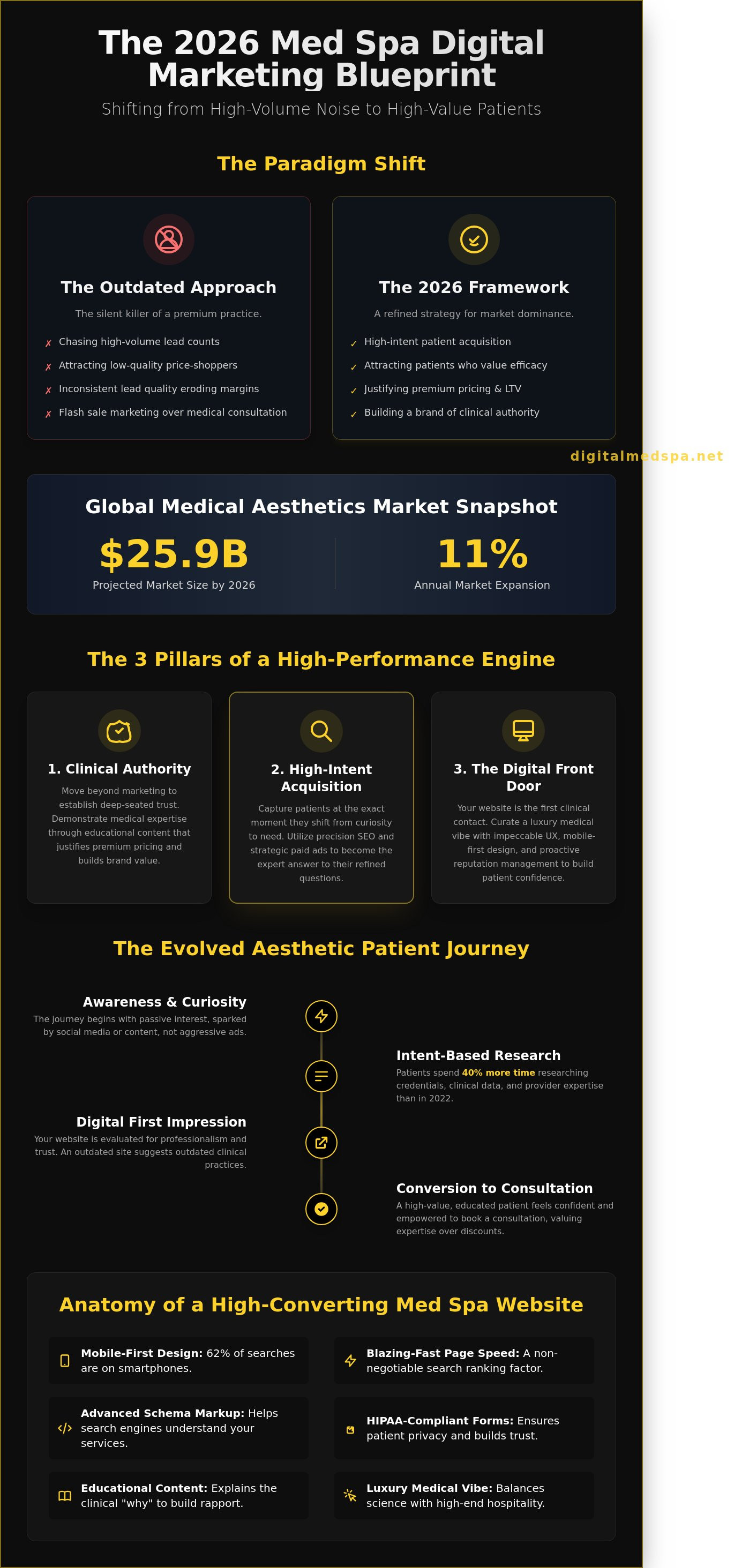
This guide introduces a refined framework that prioritizes precision and patient lifetime value over raw traffic. You'll discover how to architect a digital presence that justifies premium pricing and attracts patients who value efficacy over discounts. We'll examine the three pillars of clinical authority, high-intent lead generation, and the exact ROI tracking protocols needed to scale your practice by 2026. As the global medical aesthetics market expands by 11% annually, these strategies ensure your clinic captures the most discerning segment of the patient population through bespoke digital touchpoints.
Key Takeaways
Master the shift from high-volume noise to high-intent patient acquisition through a specialized ecosystem of clinical authority and precision SEO.
Architect a high-performance acquisition engine that utilizes bespoke website design to reduce bounce rates and guide patients toward their aesthetic journey.
Discover the strategic nuances of med spa digital marketing by identifying whether Google Ads or Meta platforms offer the highest efficacy for your specific treatments.
Elevate your practice’s local visibility and clinical credibility by optimizing your reputation management and Google Business Profile for maximum impact.
Learn how to select a strategic growth partner that prioritizes long-term brand authority and high-value patient growth over fleeting lead generation tactics.
Table of Contents What is Med Spa Digital Marketing in 2026? Building a High-Performance Patient Acquisition Engine Paid Advertising Tactics: Capturing High-Intent Leads Reputation Management and Clinical Social Proof Selecting Your Partner: The Med Spa Marketing Agency
What is Med Spa Digital Marketing in 2026?
Med spa digital marketing in 2026 functions as a specialized ecosystem where technical SEO, high-performance paid media, and proactive reputation management align to serve the modern clinic. It's no longer sufficient to generate high-volume noise or chase vanity metrics that don't convert into consultations. By 2026, the global medical aesthetics market is expected to reach $25.9 billion according to MarketsandMarkets data, creating a density that rewards precision over mere presence. Generalist agencies often struggle in this space because they don't grasp the delicate balance of clinical safety and lifestyle aspiration. They treat a neurotoxin appointment like a standard retail purchase, missing the medical nuance that high-value patients demand.
Establishing 'Clinical Authority' is the cornerstone of market dominance in this era. Patients are increasingly sophisticated and skeptical of filtered results. They seek providers who demonstrate deep medical expertise through their digital content. While foundational digital marketing strategies focus on broad visibility, experts like Digital-PR help clinics move beyond generic presence to build deep-seated trust. This authority allows a clinic to justify premium pricing, moving away from the "race to the bottom" discount culture that erodes brand value and clinical reputation.
The Evolution of the Aesthetic Patient Journey
The path a patient takes toward a procedure like body contouring or Semaglutide therapy has transformed. We've moved past the era of mindless scrolling toward a model of active, intent-based search. Patients in 2026 spend approximately 40% more time researching provider credentials and clinical white papers than they did in 2022. They're looking for science-backed evidence and natural-looking outcomes rather than exaggerated transformations. An 'Intent-First' approach to aesthetic marketing prioritizes appearing exactly when a patient shifts from curiosity to a specific medical need. It's about being the expert answer to a refined, high-intent question.
Why Your Digital Presence is Your New Front Door
Your website is the first point of clinical contact, acting as a digital concierge. The psychological impact of digital aesthetics on patient trust is immediate; a clunky or outdated interface suggests a lack of precision in the treatment room. To succeed, clinics must curate a 'Luxury Medical' vibe that balances the sterility of science with the warmth of high-end hospitality. The intersection of user experience and medical professionalism creates a sense of quiet confidence. When the digital experience is bespoke and luminous, patients feel safe and empowered about their aesthetic journey before they ever see a clinician.
Building a High-Performance Patient Acquisition Engine
Sustainable growth in 2026 requires more than a simple online presence; it demands a sophisticated digital ecosystem that mirrors the precision of your clinical work. An effective med spa digital marketing strategy functions as an automated concierge, guiding prospective patients from their initial curiosity to a confirmed consultation. This journey begins with a foundation built on technical excellence and educational depth. High-performing practices prioritize a seamless user experience that reduces friction, ensuring that site visitors remain engaged rather than bouncing to a competitor's page.
The technical backbone of your practice must be impeccable. Search engines now prioritize page speed and security as non-negotiable ranking factors. Implementing advanced Schema markup helps search algorithms understand your specific services, while adhering to FTC advertising guidelines ensures your claims remain credible and compliant. By blending these technical requirements with bespoke content that educates the reader, you position your practice as a trusted authority. This educational approach focuses on the science of rejuvenation, explaining the clinical "why" behind treatments like neuromodulators or regenerative therapy, which builds deeper rapport than a traditional sales pitch.
The Architecture of a High-Converting Med Spa Website
A premier med spa website design serves as the digital front door to your practice. It must be mobile-first, as over 62% of aesthetic searches in 2025 occurred on smartphones. Essential features include HIPAA-compliant lead forms and integrated online booking systems that allow patients to schedule appointments with a single click. To drive higher conversion rates, utilize "Clinical Social Proof." High-resolution, standardized before-and-after galleries provide the visual evidence modern consumers demand before committing to a procedure. This level of transparency transforms a passive browser into an active patient.
SEO for Aesthetic Practices: Beyond Keywords
Modern med spa seo has evolved past simple keyword stuffing. Success in 2026 hinges on E-E-A-T: Experience, Expertise, Authoritativeness, and Trust. To capture "near me" and treatment-specific queries, your content strategy should focus on high-volume treatments like Botox and laser therapy with clinical depth. By addressing specific patient concerns and providing data-backed outcomes, you satisfy both search algorithms and human intent. If you're ready to refine your digital footprint, partnering with a specialist agency can ensure your technical foundation is as flawless as your aesthetic results.
Paid Advertising Tactics: Capturing High-Intent Leads
By 2026, successful med spa advertising requires a surgical precision that balances rapid lead acquisition with long-term brand equity. The average cost-per-acquisition for aesthetic procedures reached a stable plateau in late 2025; now, profitability depends on maximizing the lifetime value of every click. Effective med spa digital marketing isn't just about visibility. It's about presence at the exact moment of desire. This requires a dual-track strategy that captures existing demand while simultaneously nurturing those who aren't yet ready to book. Budgeting for this growth involves a deep understanding of your margins. A sustainable cost-per-lead (CPL) typically ranges between $35 and $85 for injectable treatments, while high-ticket services like laser resurfacing or body sculpting often see a CPL of $125 or more. Maintaining a 3:1 return on ad spend ensures that your marketing efforts fuel clinical expansion rather than just covering overhead.
Google Ads: Capturing 'Now' Patients
Google Ads remains the powerhouse for capturing high-intent traffic. When a patient searches for "best med spa for fillers" or "CoolSculpting near me," they're signaling an immediate need. In 2026, Local Services Ads (LSAs) provide a critical layer of clinical credibility. These ads appear at the very top of search results, backed by a "Google Screened" badge that 68% of users associate with higher safety standards. Every campaign must lead to a dedicated, procedure-specific landing page. Sending traffic to a generic homepage dilutes the user experience and lowers conversion rates by up to 25%. A bespoke landing page for neurotoxins should focus on precision and safety; a page for body contouring should highlight transformative, natural-looking results through clear, clinical language.
Social Media Advertising: Creating Demand
While Google captures existing demand, Meta platforms like Instagram and Facebook excel at creating it. Your creative strategy should showcase "The Result" and "The Experience" through a lens of premium refinement. High-definition video content that explores the science behind a treatment while maintaining a luxury aesthetic outperforms static images by 3.5 times in engagement metrics. Retargeting is the bridge between a "window shopper" and a booked appointment. Since 45% of patients require multiple touchpoints before committing to a medical procedure, your ads should follow them with educational content. This builds trust without being intrusive. Compliance remains a priority. Meta's 2026 policies continue to restrict "before and after" images that imply negative self-perception. Focus instead on the luminous and rejuvenated outcomes that empower the patient, ensuring your med spa digital marketing remains both effective and ethically sound.
Reputation Management and Clinical Social Proof
Trust serves as the primary currency in the aesthetic industry. For a medical spa, reputation isn't just a byproduct of good service; it's the most significant marketing asset you possess. Potential patients prioritize safety and clinical precision above all else. They seek reassurance that your practitioners offer both the technical expertise of a medical professional and the refined touch of an artist. In 2026, your digital footprint must reflect this duality through consistent, high-quality social proof that validates your brand's promise of radiance and rejuvenation.
Google Business Profile Optimization
Your Google Business Profile (GBP) acts as the digital storefront for your practice. It's often the first point of contact for patients searching for local treatments. Optimization requires more than just filling out a form; it demands a curated presentation of your clinic's environment and expertise. Select precise categories that reflect your specialized services, such as "Medical Spa" or "Skin Care Clinic," to ensure you appear in the most relevant searches. High-resolution photos of your pristine treatment rooms and advanced technology help demystify the patient experience, creating a sense of quiet confidence before they even book a consultation.
Review velocity and sentiment now carry more weight than ever in local search rankings. Google's 2025 algorithm updates prioritize profiles that show a steady stream of fresh, detailed feedback over those with stagnant high scores. A Reputation-First SEO strategy for 2026 defines search visibility as the direct byproduct of verified clinical outcomes and consistent patient sentiment rather than mere keyword density. To maintain this momentum, you should actively engage with the Q&A section, providing authoritative answers that showcase your medical expertise while maintaining a welcoming, hospitable tone.
Handling Feedback with Grace and Authority
Managing the clinical narrative across third-party sites requires a delicate balance of professionalism and empathy. When a patient leaves a negative review, respond with the precision of a clinician and the warmth of a luxury retreat host. Acknowledge their concerns without disclosing private medical information, inviting them to a private conversation to resolve the matter. This approach demonstrates to prospective patients that you are a partner in their aesthetic journey, even when challenges arise. It transforms a potential setback into a display of your commitment to patient satisfaction and safety.
Authentic testimonials are powerful tools for med spa marketing, but they must be leveraged ethically. According to 2025 consumer data, 98% of patients read online reviews before choosing a provider. You can turn these stories into high-performing assets by highlighting specific outcomes, such as a patient's restored confidence or their luminous skin post-treatment. By fostering a community of brand advocates who share their bespoke experiences, you move beyond traditional med spa digital marketing and enter a space of earned authority and prestige.
Ready to transform your clinic's reputation into a powerful growth engine? Partner with Digital MedSpa to architect a sophisticated digital presence that commands trust and inspires action.
Selecting Your Partner: The Med Spa Marketing Agency
Choosing a partner for your practice isn't merely a business transaction; it's a commitment to your brand's clinical integrity. By 2026, the gap between "lead generation" shops and strategic growth partners has widened significantly. While lead-focused agencies prioritize raw volume, a true med spa marketing agency understands that a high volume of low-quality inquiries can drain your staff's resources and dilute your brand. You require a partner that values patient lifetime value and clinical alignment over simple click-through rates.
Ask potential partners about their HIPAA compliance protocols. Industry data from 2025 suggests that 85% of medical data breaches originated from third-party marketing integrations. Demand absolute transparency in ad spend and reporting. If an agency refuses to provide direct access to your Google Ads or Meta dashboards, they're often concealing hidden markups. Your agency should function as an extension of your medical team, respecting the precision of your craft while executing technical marketing strategies.
Red Flags to Avoid in Agency Partnerships
Be wary of firms offering guaranteed #1 rankings or instant results. Google's Search Generative Experience has made static rankings a relic of the past; modern success relies on topical authority and user intent. Agencies that don't specialize in the aesthetic industry often fail to understand the regulatory nuances of medical advertising. If a partner cannot explain the difference between a Class II and Class III medical device or the specific FDA guidelines for neurotoxin marketing, they're a liability to your practice's reputation. Other red flags include:
Lack of spend transparency: Agencies that bundle their fees with your actual advertising budget.
Generalist portfolios: Firms that market for local trades and medical practices using the same generic templates.
No lead tracking: An inability to show which specific campaigns resulted in a booked, high-value procedure.
The Digital Med Spa Advantage
Digital Med Spa represents a fusion of medical industry veterans and elite digital strategists. We don't just generate leads; we architect growth through clinical luxury and technical precision. Our approach to med spa digital marketing has helped partner practices increase their average patient lifetime value by 22% within the first twelve months of engagement. We provide bespoke consulting that goes beyond the screen to optimize your entire operation. This ensures your patient experience remains seamless from the first digital touchpoint to the final rejuvenation treatment. We treat your practice with the same meticulous care you provide your patients, ensuring every campaign reflects the luminous quality of your brand.
Securing Your Legacy in the 2026 Aesthetic Landscape
The future of aesthetics demands a shift from simple lead volume to the precise cultivation of high-value patient relationships. By 2026, success relies on a clinical-first strategy that merges advanced reputation management with high-intent paid advertising. A high-performance acquisition engine transforms a practice from a local provider into a market leader. This evolution requires more than just generic tactics; it necessitates a sophisticated approach to med spa digital marketing that prioritizes natural-looking results and patient trust.
Since 2018, Digital Med Spa has specialized in this exact methodology, helping national aesthetic practices scale through evidence-based strategies. Our team bridges the gap between medical efficacy and premium hospitality, ensuring your brand resonates with the modern, discerning client. We don't just generate clicks. We architect sustainable growth by highlighting your unique clinical expertise and the bespoke care you provide. It's time to refine your digital presence with the same precision you bring to your treatment room.
Your journey toward a more luminous and profitable future starts with a single, intentional step.
Frequently Asked Questions
How much should a med spa spend on digital marketing in 2026?
A high-growth medical spa should allocate 12% to 15% of its gross annual revenue toward its marketing efforts. While the Small Business Administration suggests a baseline of 8% for general retail, the competitive aesthetic market in 2026 demands a more robust investment to capture premium patient leads. This budget ensures your brand maintains a luminous presence across all digital touchpoints while funding the precision required for advanced targeting.
What is the best digital marketing channel for new med spas?
Google Search Ads represent the most effective channel for rapid patient acquisition because they capture immediate intent. When a patient searches for "Botox near me," they're ready to book. Industry data shows these high-intent searches convert at an average rate of 10.5%. Focusing your initial med spa digital marketing budget here ensures a steady flow of consultations while you build long-term organic authority through other avenues.
How long does it take to see results from med spa SEO?
Visible results from med spa SEO typically emerge between four and eight months of consistent optimization. Search engines prioritize websites that demonstrate clinical authority and high user engagement. By the 180-day mark, most practices observe a 25% increase in organic appointment requests as their digital footprint matures. It's a deliberate process that rewards patience with a sustainable, low-cost stream of high-value patients.
Is social media marketing or Google Ads better for aesthetic clinics?
Google Ads excel at capturing existing demand, while social media is superior for visual storytelling and brand awareness. A 2024 HubSpot study found that 54% of consumers want to see video content before committing to a clinical procedure. Use Google to secure patients who are ready to buy today. Use Instagram and TikTok to showcase your bespoke results and build the trust necessary for high-ticket rejuvenation packages.
How do I ensure my med spa marketing is HIPAA compliant?
Ensure all digital lead forms use 256-bit encryption and that your team never shares Protected Health Information (PHI) without explicit, signed authorization. The Department of Health and Human Services reported a 20% increase in healthcare data breach investigations in 2023, making security a top priority. Always sign a Business Associate Agreement (BAA) with your marketing agency to guarantee they handle patient data with clinical precision and care.
Can digital marketing help me attract more weight loss (Semaglutide) patients?
Digital marketing is the most effective way to position your clinic as a leader in the metabolic health space. With the GLP-1 market projected to reach $100 billion by 2030 according to Goldman Sachs, targeted search campaigns can connect you with patients seeking medical supervision. Focus your content on safety, efficacy, and long-term wellness to differentiate your practice from non-medical competitors and attract committed, long-term patients.
Why is a custom website better than a template for my medical spa?
A custom website provides the technical precision and bespoke aesthetic that templates can't replicate. Custom builds often achieve 50% faster loading speeds, which directly impacts your search engine rankings and user conversion rates. Your digital home should feel as refined and welcoming as your actual treatment rooms. It guides patients through a seamless journey toward rejuvenation without the cluttered code or generic feel of a standard template.
What are the most important KPIs to track for med spa digital marketing?
The most critical metrics are Patient Acquisition Cost (PAC) and Lifetime Value (LTV). You should aim for a Return on Ad Spend (ROAS) of at least 4:1 to ensure healthy margins. Track your lead-to-consultation conversion rate, which should ideally sit at 15% or higher. Monitoring these specific figures allows you to refine your med spa digital marketing strategy with the same accuracy you apply to a complex aesthetic procedure.


Comments