
The 2026 Med Spa Marketing Compliance Guide: Scaling with Clinical Authority
- Devon Kirk

- Apr 30
- 12 min read
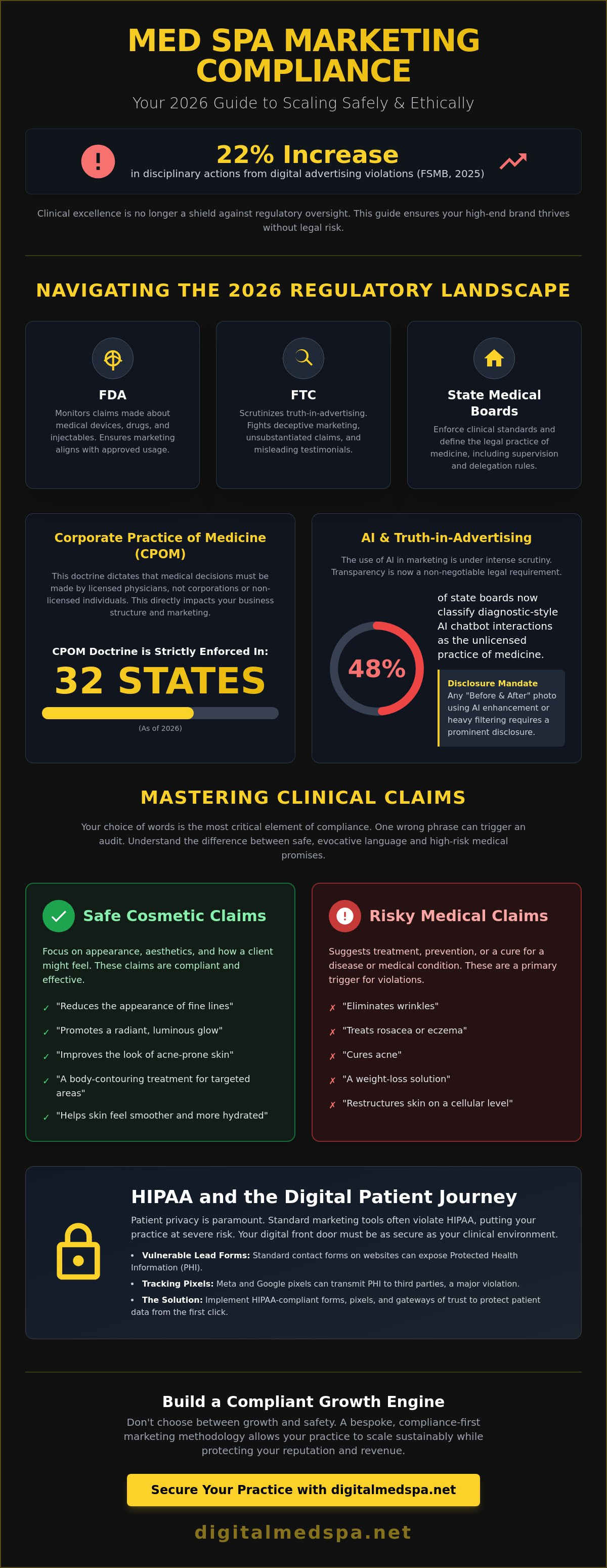
Could your most successful marketing campaign be the very thing that invites a medical board audit into your practice? In 2025, the Federation of State Medical Boards reported a 22% increase in disciplinary actions related to digital advertising violations; this proves that clinical excellence is no longer a shield against regulatory oversight. You likely feel the tension of trying to project a sense of luminous, bespoke luxury while adhering to the rigid, often confusing constraints of healthcare law. It’s a stressful balance that often leaves practitioners feeling like they must choose between stagnant growth and legal risk.
This med spa marketing compliance guide provides the clarity you need to scale with absolute precision and peace of mind. You’ll learn how to master the intersection of high-end aesthetic storytelling and strict medical regulations to protect your reputation and your revenue. We’re detailing a clear roadmap for HIPAA-compliant tracking pixels, risk-free medical claims, and the exact protocols required to build lasting patient trust through clinical authority.
Key Takeaways
Learn to harmonize medical ethics with luxury branding by navigating the 2026 regulatory standards of the FDA, FTC, and state medical boards.
Master the subtle distinction between cosmetic and medical claims to promote treatment efficacy with precision while maintaining total regulatory safety.
Navigate the complex advertising restrictions of Google and Meta with tailored strategies that protect your digital presence and drive high-end patient acquisition.
Utilize this med spa marketing compliance guide to secure your digital patient journey, transforming vulnerable lead forms into HIPAA-compliant gateways of trust.
Discover how a bespoke, compliance-first methodology allows your practice to scale sustainably without sacrificing the sophisticated aesthetic of your brand.
Table of Contents Navigating the 2026 Regulatory Landscape for Aesthetic Practices Mastering Clinical Claims: Promoting Efficacy Without Regulatory Risk Platform-Specific Compliance: Meta, Google, and Restricted Healthcare Space HIPAA and the Digital Patient Journey: Lead Capture vs. Privacy Building a Compliant Growth Engine with Digital Med Spa
Navigating the 2026 Regulatory Landscape for Aesthetic Practices
The 2026 med spa marketing compliance guide begins at the intersection of clinical excellence and consumer safety. As we move deeper into this decade, the distinction between a luxury retreat and a medical facility has become a focal point for regulators. Compliance is no longer just a legal hurdle; it's a commitment to medical ethics that protects the patient's journey toward self-confidence. By January 2026, the regulatory environment has shifted to prioritize absolute transparency, ensuring that every promise of rejuvenation is backed by scientific efficacy.
Three primary governing bodies now dictate the boundaries of your digital presence. The Food and Drug Administration (FDA) monitors claims regarding devices and injectables, while the Federal Trade Commission (FTC) scrutinizes the truthfulness of your advertising. Simultaneously, State Medical Boards enforce the clinical standards that define how medicine is practiced. To maintain a sophisticated brand, you must first understand the foundational definitions of the industry. Gaining clarity on What is a Medspa? provides the necessary context for why medical oversight is non-negotiable in a retail setting.
Central to this landscape is the Medical Director. In 2026, their role has expanded from passive oversight to active clinical approval of all marketing collateral. This ensures that every social media post and email campaign reflects the precision of a medical practice rather than the hyperbole of traditional retail. This partnership between the medical lead and the marketing team creates a sense of quiet confidence that resonates with high-end clients seeking both safety and bespoke results.
The Corporate Practice of Medicine (CPOM) and Marketing
The structure of your business ownership significantly dictates your branding strategy. Under the Corporate Practice of Medicine doctrine, which remains strictly enforced in 32 states as of 2026, the medical nature of the business must remain under physician control. This impacts how you present your identity. Using "Medical" in your name requires a higher level of clinical disclosure than using "Aesthetic" or "Wellness." To stay compliant, every digital advertisement must clearly disclose the credentials of the provider. This transparency builds trust, ensuring clients feel secure in the expert hands of licensed professionals.
AI and Truth-in-Aesthetic-Advertising
As generative technology becomes ubiquitous, the 2026 standards for "Truth-in-Advertising" have evolved to address digital alterations. Any "Before and After" photo that utilizes AI enhancement or heavy filtering must now carry a prominent disclosure. This protects the integrity of the clinical outcome and prevents the promotion of an artificial appearance. Additionally, using AI chatbots for medical triage carries significant risk; 48% of state boards now classify diagnostic-style AI interactions as the unlicensed practice of medicine. AI transparency in 2026 medical marketing is the explicit, watermark-verified disclosure of any non-human intervention used to simulate or enhance aesthetic results.
Ensure all social media captions include provider credentials.
Audit your website for "diagnostic" language in automated chat features.
Verify that your Medical Director has signed off on all active promotional claims.
Mastering Clinical Claims: Promoting Efficacy Without Regulatory Risk
Precision in language is the hallmark of a sophisticated aesthetic practice. In the 2026 med spa marketing compliance guide, the distinction between cosmetic and medical claims serves as the foundation for every digital interaction. Cosmetic claims focus on beautifying or altering the appearance, using evocative terms like "luminous" or "radiant." Medical claims, however, suggest the prevention, treatment, or cure of a disease or a change to the body's structure. If your copy promises that a laser will "cure acne" rather than "improve the appearance of acne-prone skin," you've crossed into high-risk regulatory territory.
Marketing FDA-cleared devices requires equal discipline. When promoting technologies like CoolSculpting, your messaging must align with the specific clearance for non-invasive fat reduction in targeted areas. It isn't a weight-loss solution. You're offering a bespoke body-contouring treatment, not a cure for obesity. This nuance protects your brand from the 2024 surge in FDA warning letters regarding misbranded medical devices. Similarly, the "Semaglutide Trap" has become a significant focal point for regulators. Since the FDA's 2024 updates on compounded GLP-1 medications, clinics must avoid using brand names like Ozempic or Wegovy to describe compounded versions. Your luxury marketing should emphasize "clinically supervised weight management" rather than pharmaceutical brand recognition.
The phrase "guaranteed results" has no place in a clinical luxury setting. Biology is inherently variable. Promising a 100% certain outcome violates the ethical standards set by boards such as the California Medical Board and contradicts FTC advertising compliance standards. Instead of guarantees, rely on the strength of your clinical data and the sophistication of your bespoke treatment protocols to build trust.
The Anatomy of a Compliant "Before and After"
Visual evidence must be as meticulous as your clinical technique. The FTC considers "misleading" any imagery where lighting, angles, or focal lengths change between the baseline and the result. You must use a standardized tripod setup and consistent 5500K color temperature lighting. Every gallery requires a prominent disclaimer stating that "individual results may vary." Furthermore, your patient consent forms must explicitly include a 2026-updated clause for social media and digital distribution, ensuring the patient understands their likeness will be used for global marketing.
Testimonials and the FTC Endorsement Guides
Authenticity is your greatest asset, but it must be managed with scientific rigor. You can't "cherry-pick" a single outlier result that shows a 50% reduction in fine lines if the average patient sees a 15% improvement. If you offer a $25 credit for a review, that review must include a clear disclosure of the incentive. Transition your vocabulary from "miraculous transformations" to "clinically significant improvements." This shift maintains your authority while ensuring your med spa marketing compliance guide remains a blueprint for sustainable, high-end growth.
Platform-Specific Compliance: Meta, Google, and Restricted Healthcare Space
The digital landscape for medical aesthetics in 2026 demands a sophisticated understanding of platform-specific algorithms. Google Ads continues to refine its "Healthcare and Medicines" policy, placing a premium on clinical authority and verifiable credentials. This med spa marketing compliance guide emphasizes that your digital presence must reflect the same precision as your surgical suite. Meta has increased its scrutiny on "personal health" and "body image" ads, often flagging content that implies a physical flaw or promises unrealistic transformations. TikTok also shifted its stance in late 2025, requiring clearer disclaimers for injectable treatments to protect younger demographics. To succeed, you must align your strategy with Med Spa Advertising in 2026 to ensure every touchpoint remains both compliant and conversion-focused.
Navigating the Google Ads Certification Process
Google mandates specific certifications for practitioners advertising medical services. While LegitScript is often associated with pharmacies, med spas must frequently secure healthcare provider certification to run ads for treatments like neurotoxins or weight loss injections. In 2026, Google’s AI-driven review process flags 15% more ads for "unproven medical claims" than in previous years. To avoid sudden account suspensions, ensure your landing pages meet "Your Money or Your Life" (YMYL) standards. This involves citing peer-reviewed clinical data and maintaining a visible medical director profile. When an ad is disapproved, the appeal process requires a meticulous reconciliation of your ad copy against Google’s specific policy documentation; vague requests for review rarely yield results.
Meta Pixel Compliance and Privacy
The Meta Pixel presents a significant liability when placed on pages containing sensitive patient information. Following the 2023 HHS bulletin and subsequent Braidwood rulings, the definition of protected health information has expanded significantly. You must understand how HIPAA marketing rules govern the use of these tracking technologies. It's vital to remove pixels from booking confirmation pages or any area where a patient might disclose a medical concern. Instead, sophisticated practices are transitioning to "Click-to-Message" ads. This approach initiates a bespoke, private conversation in a secure environment. It maintains the high-end hospitality your brand represents while ensuring that patient data never enters the broad data-harvesting pools of social media giants. This strategy prioritizes efficacy and safety, mirroring the clinical standards of your practice.
HIPAA and the Digital Patient Journey: Lead Capture vs. Privacy
Your website is often the first touchpoint of a patient's aesthetic journey. It should feel like a digital concierge, yet many aesthetic practices unknowingly leak sensitive data through standard marketing tools. According to the 2023 HHS guidance on tracking technologies, using third-party pixels on pages that collect health information can lead to significant regulatory penalties. As you refine your med spa marketing compliance guide for 2026, your audit must prioritize technical security alongside brand elegance.
Disable tracking pixels on intake and "thank you" pages to prevent unauthorized data sharing.
Ensure your web host and CRM provider sign a Business Associate Agreement (BAA).
Audit all third-party plugins for hidden data-sharing permissions every 180 days.
Standard lead forms are designed for speed, but medical intake requires a more secure architecture. While a simple name and email for a newsletter sign-up is generally safe, any form requesting skin concerns or treatment history must reside within a HIPAA-compliant portal. This distinction preserves the clinical integrity of your practice while maintaining the seamless experience expected in Med Spa Marketing in 2026. Professionalism starts with the safety of a client's most personal information.
Compliant Email and SMS Marketing
Modern patients appreciate the convenience of SMS reminders, but these communications must be handled with precision. 2026 standards require a documented double opt-in for all marketing lists. This ensures the recipient has explicitly requested to receive messages on their private device. When sending treatment follow-ups, use encrypted platforms that protect Protected Health Information (PHI). If a patient requests the "Right to be Forgotten," you must distinguish between marketing records and the mandatory retention of medical charts required by state medical boards.
Managing Online Reputation Safely
Responding to reviews is a delicate art where hospitality meets legal restriction. You cannot confirm "patient status" even if the reviewer provides their full name and treatment details. The "Bespoke Response" strategy involves addressing the sentiment of the review without confirming the individual ever stepped foot in your clinic. The boundary between customer service and medical disclosure is crossed the moment a response confirms that an individual has received a specific treatment or visited the clinic. Always invite the conversation into a private, secure setting to resolve concerns. This approach protects your med spa marketing compliance guide strategy while demonstrating a high level of professional care.
Ensure your digital presence is as secure as your clinical suite. Partner with Digital MedSpa to build a compliant, high-conversion growth engine.
Building a Compliant Growth Engine with Digital Med Spa
Generalist marketing agencies often treat aesthetic treatments like standard retail products, failing to grasp the intricate legalities governing medical procedures. This oversight creates significant risk for practitioners who must answer to strict regulatory bodies. At Digital Med Spa, we prioritize a Compliance-First philosophy. Our bespoke website designs aren't just visually stunning; they're built to satisfy the rigorous oversight of state medical boards and federal privacy laws. We ensure your digital presence reflects the same clinical precision you apply in the treatment room.
Scaling a practice requires more than just high-volume lead generation. It demands a strategic framework that accounts for the evolving med spa marketing compliance guide requirements. Our business coaching services provide the clarity needed to navigate these complexities. We help you implement operational systems that protect your professional license while driving sustainable revenue. When you're choosing a med spa marketing agency, you deserve a partner that understands the weight of your medical credentials and the nuances of aesthetic law.
From Clinical Precision to Luminous Results
We seamlessly integrate safety protocols into high-end brand storytelling. This approach ensures your marketing feels like a luxury experience rather than a cold clinical manual. Our team possesses the unique ability to satisfy both technical SEO algorithms and the ethical standards required for medical advertising. By combining medical efficacy with a luminous aesthetic, we attract high-value patients who prioritize quality over discounts. This med spa marketing compliance guide is the foundation of our work. We invite you to a strategy consultation to build a compliant 2026 growth map tailored to your unique vision.
The Digital Med Spa Advantage
Our specialized expertise in Google Business Profile optimization ensures your practice maintains its local authority and visibility. We manage your online reputation with a focus on protecting both your license and your brand's prestige. We don't use aggressive sales tactics; instead, we rely on the sophistication of your results and the clarity of your message to drive conversions. By focusing on customized treatment plans and natural-looking outcomes, we establish you as a modern expert in the field. Partner with Digital Med Spa to secure your future in the aesthetic industry and achieve the growth your expertise deserves.
Fortify Your Aesthetic Legacy for 2026
The 2026 regulatory landscape demands a delicate balance between ambitious growth and technical accuracy. Mastering HIPAA-compliant lead capture and navigating the intricate claim restrictions on Meta and Google are essential pillars for those seeking to lead the luxury market. This med spa marketing compliance guide serves as your blueprint for maintaining clinical authority while delivering the luminous results your patients expect. Success in the modern aesthetic era requires a partner who understands that safety protocols and premium refinement are two sides of the same coin.
Digital MedSpa brings over 8 years of specialized experience to your brand, ensuring every campaign adheres to the latest FDA and HIPAA marketing regulations. We build bespoke, high-performance websites designed for clinical luxury, protecting your reputation while you focus on the art of rejuvenation. It's time to transform complex regulatory challenges into a distinct competitive advantage that empowers your practice's long-term vision.
Your journey toward a more secure and radiant future starts with a single, intentional step.
Frequently Asked Questions
Is it legal to use "Before and After" photos in med spa ads?
Yes, using "Before and After" imagery is legal as long as the results are authentic and unedited. The FTC requires that 100% of these photos represent typical results without digital enhancement or deceptive lighting. You must secure a signed HIPAA media release for every patient featured. This ensures your clinical authority remains untarnished by claims of deceptive advertising while showcasing the radiance you provide.
Do I need a special certification to run Google Ads for Botox or fillers?
You must obtain LegitScript certification to run Google Ads for prescription treatments like Botox or dermal fillers. Google updated its healthcare policy in 2023 to require this verification for all providers offering prescription-only medications. Without this certification, which involves an annual fee, your ads will be flagged and paused. This process validates your credentials and ensures your marketing meets high safety standards.
How does HIPAA affect my Facebook and Instagram marketing?
HIPAA mandates that you never share Protected Health Information on social media without explicit, written consent. This med spa marketing compliance guide emphasizes that even responding to a patient's comment can be a violation if it confirms their treatment status. Since 2022, the Office for Civil Rights has increased enforcement regarding social media interactions. You must manage every interaction with clinical precision to protect patient privacy.
Can I offer discounts for reviews on my Google Business Profile?
Offering discounts or incentives for reviews is a direct violation of Google’s Terms of Service and FTC guidelines. In 2024, the FTC finalized a rule that bans businesses from buying or incentivizing reviews with fines reaching $51,744 per violation. Authentic feedback is the cornerstone of your brand's integrity. Focus on providing a bespoke experience that naturally encourages patients to share their luminous results without financial persuasion.
What are the risks of marketing Semaglutide or Tirzepatide in 2026?
Marketing these peptides carries significant legal risk due to trademark enforcement and FDA compounding regulations. In 2023, manufacturers filed over 40 lawsuits against clinics for improper use of brand names like Ozempic or Mounjaro. You must use generic names and ensure your claims align with FDA-approved indications. This careful approach maintains your clinical credibility while protecting your business from high-stakes litigation and ensuring patient safety remains the priority.
What is the "Corporate Practice of Medicine" and why does it matter for marketing?
The Corporate Practice of Medicine is a legal doctrine in 30 states that prevents non-physicians from practicing medicine or owning a medical clinic. Your marketing must reflect that a licensed physician directs all clinical decisions to remain compliant. This med spa marketing compliance guide helps you navigate these boundaries by focusing on the partnership between medical expertise and aesthetic artistry. It ensures your business structure supports long-term growth.
Is my med spa website required to be ADA and HIPAA compliant?
Your website must adhere to Title III of the ADA and HIPAA privacy standards to protect your practice. A 2023 report showed a 12% increase in ADA-related website lawsuits against small businesses. Additionally, the HHS issued guidance in December 2022 warning against using tracking pixels that share patient data with third parties. A compliant website provides a secure, accessible gateway for clients seeking your advanced and refined aesthetic solutions.
How can I mention my Medical Director in my marketing materials?
You should identify your Medical Director by their full name, medical degree, and board certifications in all promotional materials. State boards, such as the Medical Board of California, require this transparency to ensure patients know who is responsible for their care. This practice builds a foundation of trust and highlights the efficacy of your treatments. It positions your spa as a leader in clinical excellence and refined patient safety.


Comments