
Why Your Med Spa Ads Are Not Converting: Solving the Aesthetic Growth Gap
- Devon Kirk

- May 2
- 12 min read
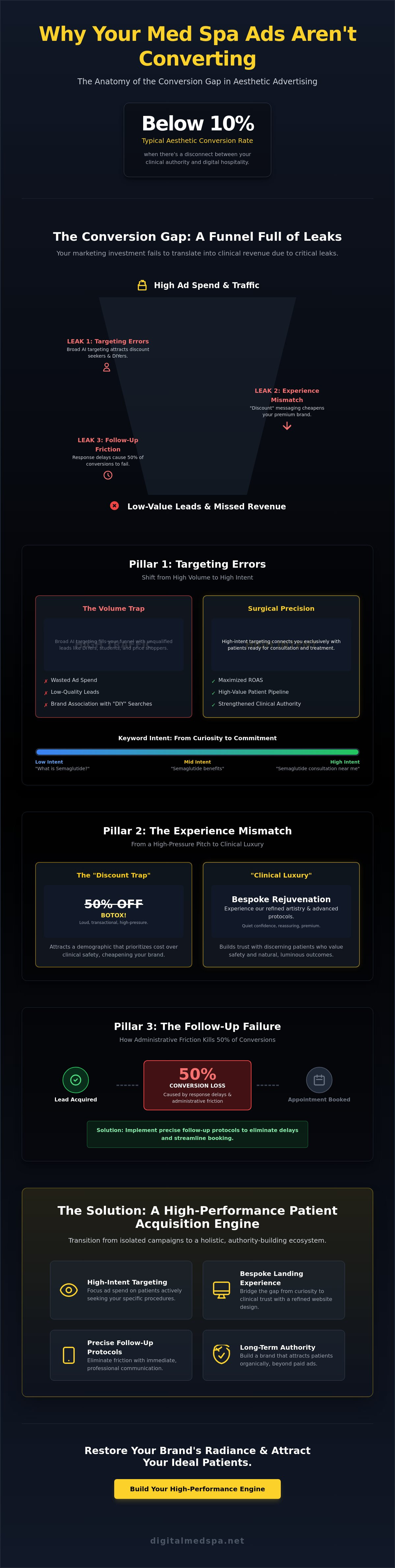
What if the very ads designed to grow your practice are actually eroding the prestige you've spent years building? You likely recognize the frustration of investing thousands into digital campaigns only to receive leads who prioritize discounts over your clinical expertise. It's exhausting to watch your premium brand feel cheapened by aggressive tactics that fail to mirror the bespoke experience you provide within your clinic walls. According to 2023 industry benchmarks, aesthetic conversion rates often stall below 10% when there's a disconnect between clinical authority and digital hospitality. This leaves you questioning why my med spa ads are not converting into the high-value patient appointments your team deserves.
This diagnostic exploration identifies the specific technical and psychological leaks within your current advertising funnel. We'll show you how to bridge the gap between medical precision and luxury hospitality to ensure your marketing spend attracts discerning individuals. You'll gain a clear roadmap to restore your brand's radiance while building a pipeline of patients who value your safety protocols and refined artistry over the lowest price point. It's time to move beyond high-cost clicks and toward a sustainable, sophisticated growth strategy.
Key Takeaways
Learn to navigate the 2026 shift toward high-intent targeting, moving away from broad AI-driven volume that attracts discount seekers rather than loyal patients.
Discover how a refined landing experience and bespoke website design bridge the gap between initial curiosity and clinical trust.
Pinpoint the exact psychological and technical leaks to finally understand why my med spa ads are not converting into premium patient revenue.
Implement precise follow-up protocols to eliminate the 50% conversion loss typically caused by response delays and administrative friction.
Transition from isolated tactical campaigns to a holistic marketing ecosystem that combines sophisticated advertising with long-term authority.
Table of Contents The Anatomy of the Conversion Gap in Aesthetic Advertising Targeting Errors: Why High Volume Often Leads to Low Conversion The Landing Experience: Where Luxury Meets Clinical Authority Beyond the Click: Follow-Up Friction and Ad Compliance Architecting a High-Performance Patient Acquisition Engine
The Anatomy of the Conversion Gap in Aesthetic Advertising
The Conversion Gap is the silent, expensive space where your marketing investment fails to translate into clinical revenue. It's a common frustration for practice owners who see healthy traffic on their dashboards but empty chairs in their treatment rooms. If you find yourself wondering why my med spa ads are not converting, the issue rarely stems from a single technical error. Instead, it's often a failure of Conversion rate optimization (CRO) to align your digital presence with your physical excellence. In 2026, patients are more discerning than ever; they've become immune to the loud, neon-colored "flashy" ads that dominated previous years. They're looking for "Clinical Luxury," a seamless continuity where the precision of medical science meets the warmth of high-end hospitality. To close this gap, your strategy must rest on three pillars: Intent, Experience, and Trust.
The "Discount Trap" and Its Impact on ROAS
Many practices fall into the trap of using heavy discounts to drive volume. While a "50% off" headline might spike your click-through rate, it often attracts a demographic that prioritizes cost over clinical safety. This creates a low-price anchor in the patient's mind, making it difficult to transition them into high-value, bespoke treatment plans later. When your messaging focuses on being the "cheapest" option, you inadvertently cheapen your brand's authority. To improve your Return on Ad Spend (ROAS), pivot your messaging toward bespoke results and the efficacy of your advanced protocols. Patients seeking rejuvenation are often willing to invest more in a practitioner who promises a natural, luminous outcome rather than just a bargain.
The Searcher’s Psychology: From Curiosity to Commitment
A patient's journey toward aesthetic treatment is deeply emotional. They aren't just searching for a procedure; they're looking for a partner to help restore their confidence. If your ads feel like a high-pressure sales pitch, you'll lose them before they even reach your landing page. High click-through rates are merely vanity metrics if they don't lead to a meaningful consultation. Successful medical marketing relies on quiet confidence and reassurance. By presenting your practice as a trusted, modern expert, you move the searcher from idle curiosity to a firm commitment. It's about showing them that their aesthetic journey will be handled with the same meticulous care you'd provide in a clinical suite, yet wrapped in the tranquility of a wellness retreat. This psychological alignment is the first step in fixing the leak in your conversion funnel.
Targeting Errors: Why High Volume Often Leads to Low Conversion
Digital advertising platforms in 2026 have shifted heavily toward AI-driven automation, often prioritizing sheer traffic volume over clinical intent. While broad targeting might look impressive on a monthly report, it's frequently the primary reason why my med spa ads are not converting. High-performance aesthetic marketing requires a surgical level of precision that algorithms often overlook in favor of reaching the widest possible audience. When you prioritize volume over intent, you're essentially paying for clicks from individuals who may never have the desire or the means to step through your doors. Maximizing digital marketing spend requires a disciplined approach to audience curation, ensuring your message reaches those seeking the specific, high-end results you provide.
A common pitfall involves ads appearing for "DIY" or "Training" searches. If your negative keyword list isn't meticulously maintained, your budget could be consumed by individuals looking for "Botox certification" or "at-home chemical peels" rather than patients seeking professional rejuvenation. Protecting your investment means explicitly excluding terms that signal educational or amateur interest. This level of detail-oriented management ensures your brand remains associated with clinical authority rather than general information gathering.
Keyword Intent vs. Patient Readiness
Distinguishing between curiosity and commitment is vital for a healthy conversion rate. A search for "What is Semaglutide" represents someone at the beginning of their educational journey, likely months away from a booking. Conversely, "Semaglutide consultation near me" indicates a patient ready for a medical evaluation. By focusing on service-specific long-tail keywords, you ensure your ad spend reaches individuals seeking the expertise your clinic provides. This strategic focus transforms your ads from a broad net into a precision tool, capturing high-intent traffic that values efficacy and safety. A partner like Digital MedSpa can help you refine these parameters to ensure your messaging aligns with the patient's current emotional state.
Geographic and Demographic Precision
National reach is a fallacy for local medical practices. Hyper-Local Targeting is the cornerstone of med spa PPC, ensuring your message only reaches those within a practical driving radius of your facility. Layering this geographic focus with demographic data, such as high-net-worth indicators and lifestyle interests, allows you to speak directly to discerning clients who value artistry over a bargain. Precision targeting prevents your brand from feeling overexposed and maintains the exclusivity of your practice. Hyper-Local Targeting is the strategic practice of concentrating your digital presence within a specific, high-intent radius of your clinical facility to ensure every click has the potential to become a physical appointment.
The Landing Experience: Where Luxury Meets Clinical Authority
Even with surgical precision in your targeting, the destination often dictates the final result. If you find yourself wondering why my med spa ads are not converting, the problem frequently stems from a disconnect between the ad's promise and the landing page experience. Sending high-intent traffic to a generic homepage is the most common reason for conversion failure. A homepage is designed to serve many masters, but a dedicated landing page focuses on a singular solution, guiding the patient from initial curiosity to a confident booking. It's about maintaining the "Clinical Luxury" thread from the first click to the final confirmation.
In the modern market, sophisticated med spa website design must function as a digital concierge. It should strike a delicate balance between clinical efficacy and aesthetic radiance. Patients need to see the science behind the results, yet they also crave the tranquility of a premium wellness environment. This dual approach ensures that every visitor feels both safe in expert hands and excited about their aesthetic journey. When your digital presence mirrors the high-end hospitality of your physical spa, trust is established instantly.
The First Three Seconds: Visual Authority
Visual first impressions are formed in less than three seconds. During this window, your practice must communicate authority and luxury without saying a word. High-resolution, custom imagery of your actual clinic and staff is essential; generic stock photos are easily identified and immediately erode trust. Because 82% of aesthetic searches in 2024 originated on mobile devices, your page must be flawlessly responsive. The strategic use of white space and elegant typography creates a sense of calm and organization, mirroring the meticulous nature of your medical procedures.
Trust Signals and Social Proof Integration
Trust is the currency of the aesthetic industry. Your landing page must serve as a gallery of your expertise, featuring prominently placed before/after photos that showcase natural-looking results. These galleries act as clinical evidence of your skill and precision. Additionally, integrating real patient testimonials that focus on the emotional journey, rather than just the technical outcome, provides the reassurance new patients seek. By combining clinical credentials with authentic social proof, you transform a simple webpage into a high-performance patient acquisition engine that honors the sophistication of your brand.
Beyond the Click: Follow-Up Friction and Ad Compliance
Conversion doesn't end with a click. It's the precise moment where digital interest must transform into clinical commitment through a seamless, high-touch follow-up process. If you're still questioning why my med spa ads are not converting, the answer often lies in the "Speed to Lead" reality. A 30-minute delay in responding to a digital inquiry can result in a 50% decrease in conversion probability. Discerning patients seeking aesthetic rejuvenation expect the same responsiveness online that they receive in your physical lobby. When that expectation isn't met, the sense of luxury and clinical authority you've built begins to erode rapidly.
Invisible friction also plays a significant role in losing potential patients. Complex booking forms with too many required fields or the frustration of repetitive "phone tag" can alienate a high-value lead before they even meet your team. Every additional step in the digital journey is an opportunity for a patient to reconsider. Implementing HIPAA-compliant lead handling is not merely a legal checkbox; it's a profound signal of respect for the patient's privacy and clinical safety. This commitment to security builds a foundation of trust that is essential for any medical procedure. Our team at Digital MedSpa specializes in auditing these operational leaks to ensure your practice captures every high-value opportunity.
The Human Element in Digital Conversion
Your front desk serves as your most vital marketing department. Ad-generated leads require a different approach than established referrals. They need immediate reassurance, expert education, and a warm, guiding hand. Training your staff to handle these inquiries with the same precision and hospitality found in a consultation is essential. This creates a seamless handoff from the digital ad to the physical clinic, ensuring the patient feels safe and valued throughout their entire journey. When the human touch matches the digital promise, conversion rates naturally stabilize.
2026 Compliance: Meta and Google Medical Policies
Navigating the strict 2026 ad compliance landscape requires a meticulous understanding of "Personal Health" restrictions. Both Meta and Google have intensified their scrutiny of medical treatments, often flagging ads that promise unrealistic results or use invasive imagery. Modern medical advertising in 2026 demands absolute transparency regarding data collection and treatment efficacy to satisfy both platform algorithms and patient skepticism. Success requires a balance of clear privacy policies and transparent data handling. By aligning your creative strategy with these evolving standards, you protect your practice from ad account suspensions while reinforcing your brand's reputation as a trusted, modern expert.
Architecting a High-Performance Patient Acquisition Engine
Building a sustainable practice requires moving beyond the frustration of individual campaign failures. Sophisticated med spa advertising is not an isolated tactic; it's a precision instrument that works in synergy with long-term SEO to create a multi-layered digital presence. While ads capture immediate interest, your organic authority provides the quiet reassurance a patient needs to finalize their decision. This "Growth Map" approach shifts your focus from short-term tactical fixes to a holistic marketing ecosystem that honors both clinical science and luxury hospitality. Understanding this integration helps clarify why my med spa ads are not converting when they're left to stand alone without the support of a broader brand narrative.
A high-performance engine requires measuring the metrics that truly impact your bottom line. We move the conversation away from vanity metrics like Cost Per Click (CPC) and toward Patient Acquisition Cost (PAC). In 2026, the success of your med spa marketing is defined by the lifetime value of the patients you attract rather than the sheer volume of leads. By focusing on PAC, you ensure that your advertising spend is an investment in loyal clients who value natural-looking results and the meticulous safety protocols of your practice. This strategic shift preserves your brand prestige while ensuring consistent, high-value growth.
Data-Driven Optimization and Scaling
Precision in aesthetics requires constant refinement, and your marketing should be no different. We utilize advanced conversion tracking to identify exactly which creative assets and keywords drive actual consultations. Attribution modeling in the 2026 patient journey is essential; it allows us to see how multiple touchpoints, from a social media post to a search ad, culminate in a booking. You're ready to scale your budget only when your internal operations can maintain a 90% or higher response rate to new inquiries. This data-driven discipline ensures that every additional dollar spent serves to amplify your success rather than increasing your waste.
The Digital Med Spa Advantage
Bridging the gap between clinical authority and luxury hospitality is a delicate art. Partnering with a specialized med spa marketing agency provides you with the technical expertise and the aesthetic sensibility required to attract discerning patients. Beyond digital strategy, our focus on business coaching helps optimize your internal sales and operations, ensuring your team is prepared to deliver a bespoke experience from the first phone call. It's time to stop chasing clicks and start architecting a legacy of radiance and trust. Book a strategic consultation with Digital Med Spa to begin your journey toward a more sophisticated and profitable practice.
Cultivating a Legacy of Clinical Radiance
Restoring your brand's prestige begins by acknowledging that a high click-through rate is merely a vanity metric without the support of clinical authority and high-end hospitality. You've discovered that solving the mystery of why my med spa ads are not converting requires a shift from broad volume to high-intent targeting and a landing experience that mirrors the precision of your treatments. By eliminating follow-up friction and ensuring your systems remain HIPAA-compliant, you protect both your patients and your reputation as a trusted provider.
Since 2018, Digital MedSpa has served as a specialized partner for medical and aesthetic practitioners, acting as clinical luxury branding experts. We provide the technical depth and sophisticated, HIPAA-compliant marketing systems necessary to turn digital interest into loyal patient appointments. It's time to move beyond tactical guesswork and embrace a holistic ecosystem designed for sustainable growth. We invite you to Request Your Aesthetic Practice Growth Map Today and take the first step toward a more luminous future. Your journey to aesthetic excellence deserves a partner who values precision as much as you do.
Frequently Asked Questions
Why are my med spa Google Ads getting clicks but no phone calls?
Clicks without calls typically indicate a disconnect between the patient's search intent and the landing page experience. If your ad promises a specific solution like "under-eye rejuvenation" but leads to a generic homepage, the visitor loses interest within seconds. This friction prevents them from taking the next step toward a consultation. Establishing immediate clinical authority and providing a clear, luminous path to booking is essential to turn those clicks into conversations.
How much should a typical medical spa spend on advertising in 2026?
According to 2024 industry benchmarks from the American Med Spa Association, established practices often allocate between 10% and 15% of their total gross revenue toward marketing. This investment supports a mix of high-intent search ads and brand awareness campaigns. For newer clinics looking to capture market share, this percentage may increase to 20% to ensure a robust initial patient pipeline. A disciplined budget ensures your brand remains visible without sacrificing the quality of your messaging.
What is a good conversion rate for a med spa landing page?
A high-performance landing page in the aesthetic sector should aim for a conversion rate between 10% and 15% for new patient inquiries. If your current rate is hovering below 5%, it's a primary indicator of why my med spa ads are not converting into tangible revenue. This gap often stems from slow mobile load times or a lack of trust signals, such as clinical credentials and authentic before/after galleries. Refining these elements can lead to a 20% increase in lead volume without increasing your ad spend.
Should I use Facebook or Google Ads for my aesthetic practice?
The most effective strategy in 2026 involves a sophisticated blend of both platforms to capture patients at different stages of their journey. Google Ads are ideal for capturing high-intent searches where a patient is actively looking for a specific treatment like "Botox near me." Facebook and Instagram are superior for visual storytelling and nurturing curiosity through elegant imagery and educational content. Using both ensures you're present when patients are searching for solutions and when they're simply seeking inspiration.
Why do my ad leads always ask for discounts and never book full-price treatments?
This trend is usually a symptom of "price anchoring" within your advertising creative. When ads lead with heavy discounts or "limited time deals," they attract a demographic that prioritizes cost over clinical expertise and safety. To attract high-value patients, your messaging must pivot toward bespoke results and the precision of your medical protocols. Focusing on the "luminous" and "natural" outcomes you provide creates a perception of luxury that justifies premium pricing.
How can I track which ads are actually resulting in Botox or Filler patients?
Successful tracking requires the integration of Google Analytics 4 with a HIPAA-compliant CRM system. By using unique tracking parameters for each ad group, you can follow a patient's journey from their initial click to their physical appointment. This data-driven approach allows you to identify exactly which keywords result in high-value procedures rather than just generic inquiries. It's the only way to ensure your marketing spend is contributing to the long-term growth of your practice.
Does my med spa website design really affect my ad performance?
Your digital presence is a direct reflection of your clinical skill; 82% of patients in a 2024 survey stated that a clinic's website influenced their perception of the provider's expertise. A cluttered or outdated design creates immediate doubt about the precision of your medical work. Conversely, an elegant, mobile-responsive site with plenty of white space and bespoke imagery reinforces your brand's sophistication. High-quality design reduces bounce rates and significantly improves the return on your advertising investment.
What are the most common HIPAA mistakes in med spa advertising?
The most frequent errors involve using non-encrypted contact forms and failing to obtain specific marketing consent for before/after photos. Simply having a patient sign a general medical release isn't sufficient for digital advertising purposes. You must ensure that all lead data is captured and stored within a secure, encrypted environment to avoid significant legal liabilities. Prioritizing these safety protocols not only protects your practice but also builds deep trust with your discerning patient base.


Comments